Our time · war
Yom Kippur War
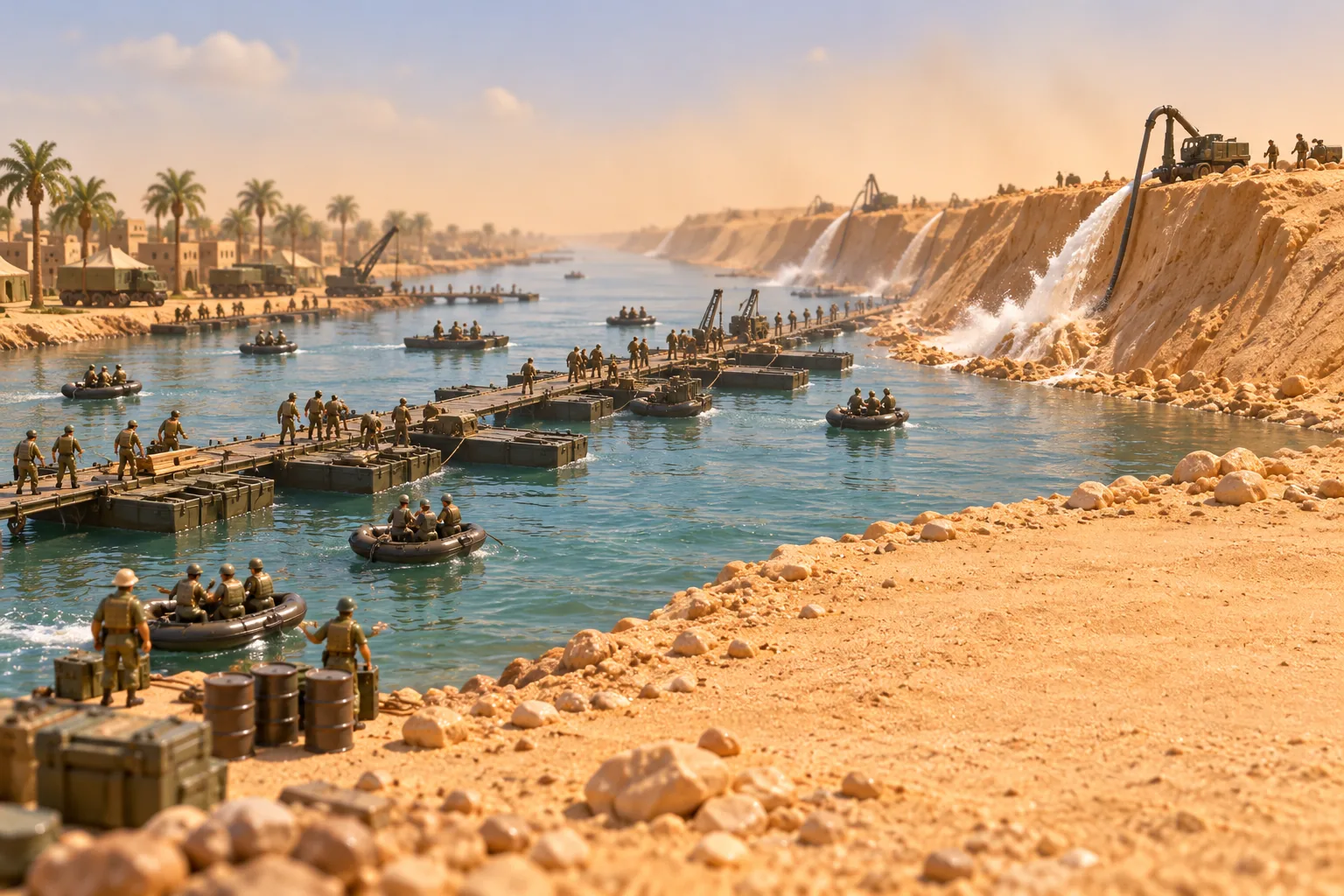
Egyptian engineers broke through Israel's giant sand walls on the Suez Canal with an unexpected weapon: high-pressure water cannons.
In the Six-Day War of 1967 Israel had captured Egypt's Sinai Peninsula and part of Syria's Golan Heights. Along the east bank of the Suez Canal it built the Bar Lev Line, a chain of forts behind tall sand ramparts. Egypt's president Anwar Sadat and Syria's leader Hafez al-Assad prepared to take the lost land back. They struck on 6 October 1973, Yom Kippur, the holiest day of the Jewish year, which that year fell on the tenth day of Ramadan.
At 2 p.m. more than 200 Egyptian aircraft attacked, and over 2,000 guns shelled the Bar Lev Line for 53 minutes. Egyptian troops crossed the canal in Operation Badr and blasted gaps in the sand walls with water from the canal itself, while Syrian tanks pushed into the Golan. After three days Israel stopped the Egyptian advance and drove most of the Syrians back, then counterattacked towards Damascus. The United States flew in arms to Israel in Operation Nickel Grass, and the Soviet Union supplied the Arab states. Israeli forces then crossed the canal and threatened to cut off the Egyptian Third Army.
A UN ceasefire on 22 October broke down, and a second one on 25 October ended the war. In Israel the surprise led to the Agranat Commission, and Prime Minister Golda Meir resigned on 11 April 1974. The war opened a road to peace: the Camp David Accords of 1978 and the Egypt–Israel peace treaty, under which Israel returned the Sinai to Egypt.
Read more on Wikipedia
Sources: en.wikipedia.org/wiki/Yom Kippur War