
Ancient world · culture
Writing
The first writing was not poetry or law but bookkeeping: tallies of grain and animals pressed into wet clay in the city of Uruk.
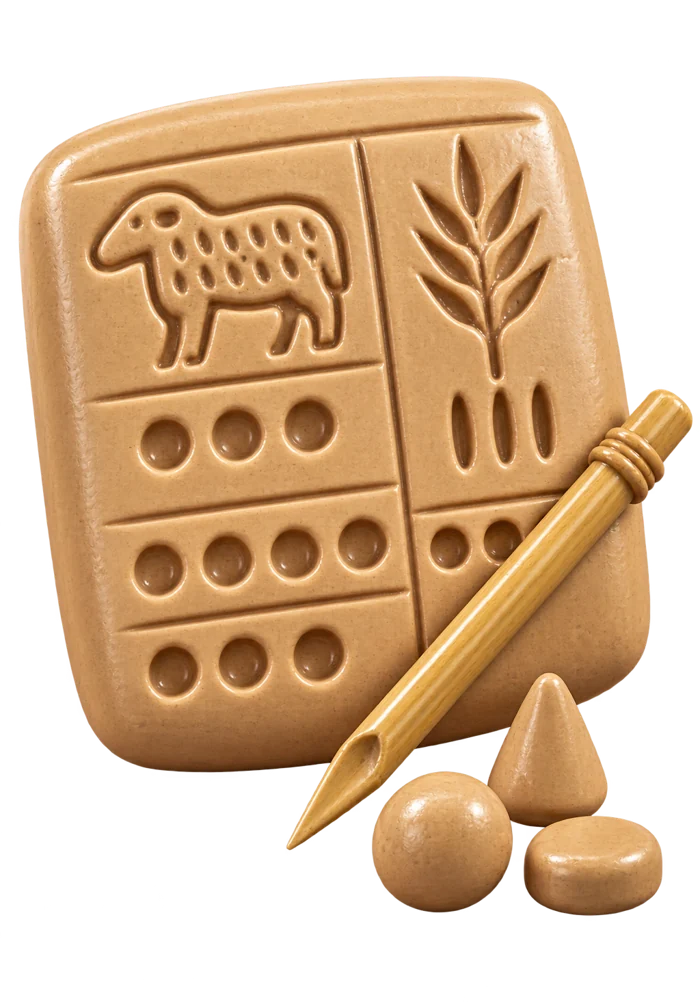
Long before writing, people in the Near East kept accounts with small clay tokens, each standing for an amount of livestock or goods. The tokens were pressed onto the surface of round clay envelopes and then sealed inside them. Over time the envelopes gave way to flat tablets, and the tokens to signs drawn with a stylus. By around 3300 BC scribes in Uruk, a city in southern Mesopotamia, were making the first unmistakable written documents.
Those early tablets were drawn in pictures with a sharpened reed, and almost all of them were accounts. Around the middle of the 3rd millennium BC scribes began pressing a wedge-tipped stylus into the clay instead, which was quicker, and the pictures turned into clusters of wedges. That is where the name comes from: cuneiform, from the Latin cuneus, 'wedge'. Signs came to stand for sounds as well as things, so the script could record names, grammar and, in time, literature.
Cuneiform outlived the Sumerian language itself. It was adapted for Akkadian, Hittite, Elamite and other tongues and stayed in use for more than three thousand years; the last firmly dated tablet, an astronomical text from Uruk, was written in AD 79/80. Then it was forgotten so completely that 19th-century scholars had to decipher it from scratch. About half a million tablets sit in museums today, some 130,000 in the British Museum alone, and comparatively few have been published.
Read more on Wikipedia
Sources: en.wikipedia.org/wiki/Cuneiform, en.wikipedia.org/wiki/Kushim (Uruk period)
