Our time · culture
Woodstock
The organisers promised the town 50,000 visitors; nearly half a million turned up, and the fences were never finished.
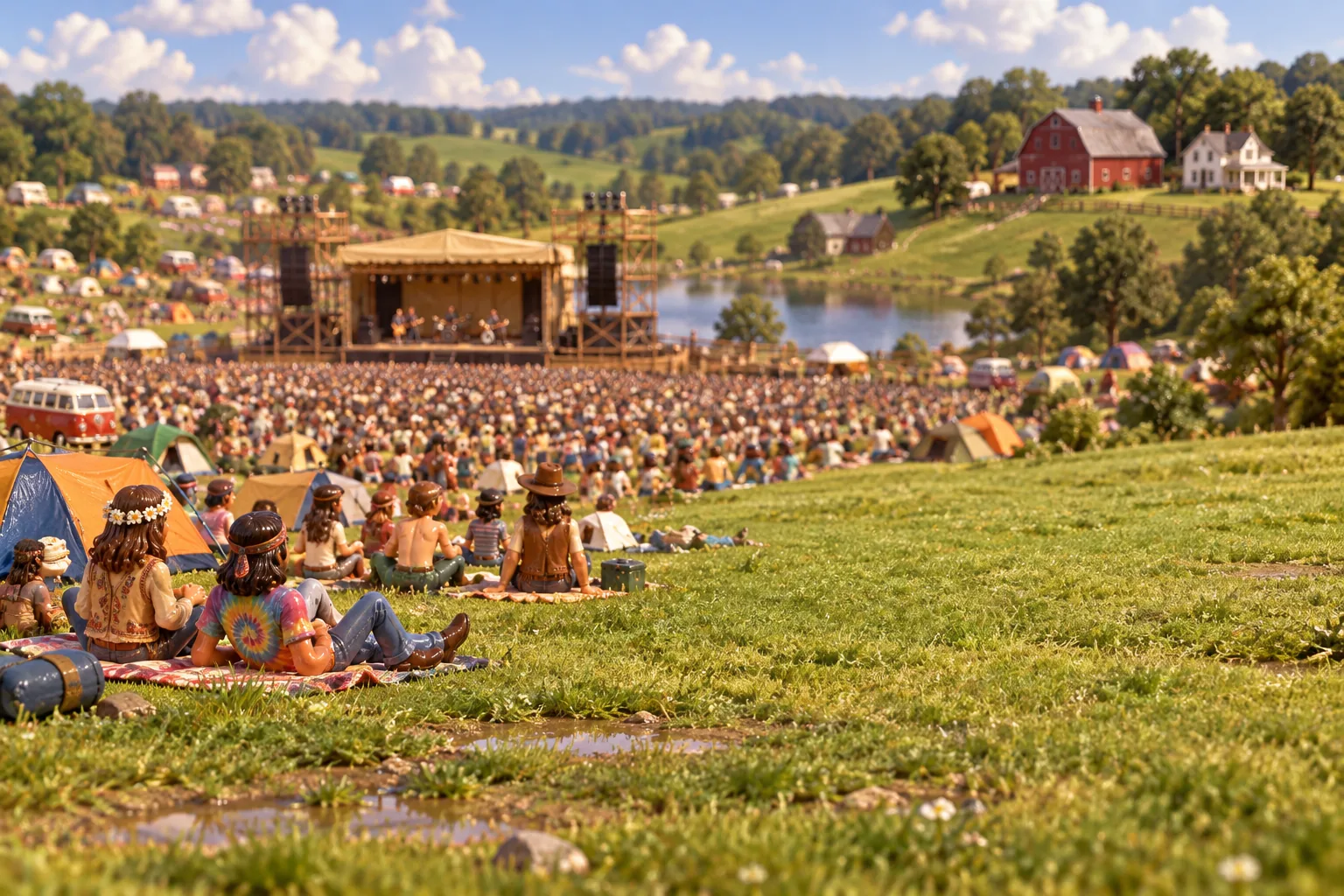
Woodstock was the idea of four young men: Michael Lang, Artie Kornfeld, Joel Rosenman and John P. Roberts, who put up the money. They meant to hold it near the town of Woodstock, New York, but residents there said no, and in July 1969 the town of Wallkill banned the event with a new permit law. The promoters then found Max Yasgur's dairy farm in Bethel, about 60 miles to the southwest. Its fields formed a natural bowl sloping down to a pond, with the stage at the bottom. Some locals put up signs reading "Buy No Milk. Stop Max's Hippy Music Festival".
Billed as "an Aquarian Exposition: 3 Days of Peace & Music", the festival opened on 15 August. About 186,000 advance tickets had been sold at $18, but the fences and ticket booths were not ready, so it became a free concert. Roads jammed, rain turned the fields to mud, and food, toilets and first aid ran short. Sullivan County declared a state of emergency, and helicopters flew performers in and out. Thirty-two acts played, among them Santana, Janis Joplin, Jefferson Airplane and Creedence Clearwater Revival.
Delays pushed the last act, Jimi Hendrix, to 8:30 on Monday morning, when only about 30,000 people were left from a peak of some 450,000. His version of "The Star-Spangled Banner" became one of the sounds of the decade. Despite the chaos the crowd stayed remarkably peaceful. A 1970 documentary film and Joni Mitchell's song "Woodstock" made it a legend.
Read more on Wikipedia
Sources: en.wikipedia.org/wiki/Woodstock


