
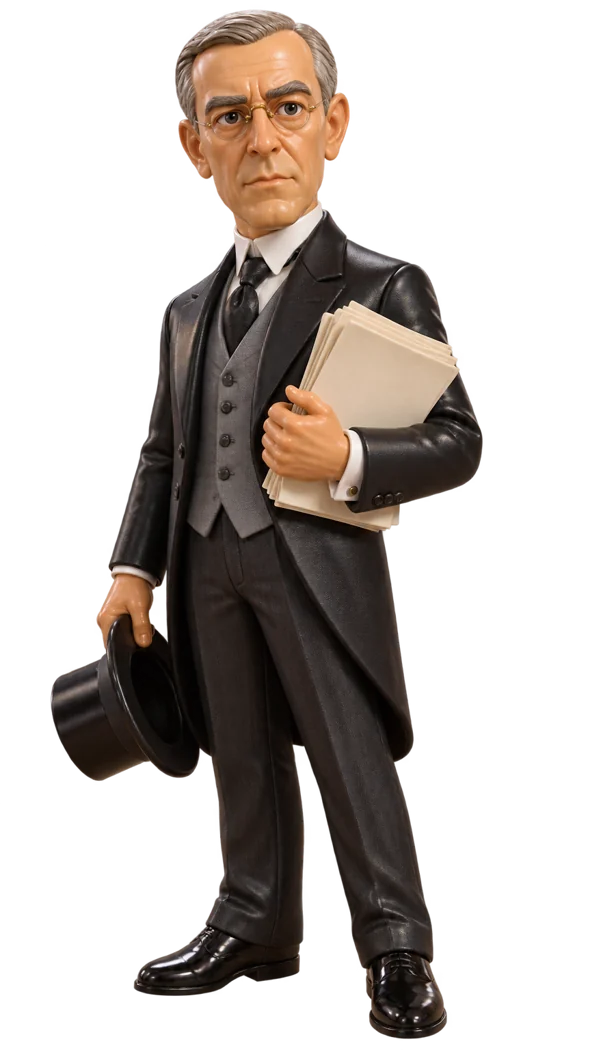
Industrial age · person
Woodrow Wilson
He was the first sitting American president to cross to Europe, and he stayed for six months, determined to write a peace that would end war for good.
Thomas Woodrow Wilson was born in Staunton, Virginia, on 28 December 1856, the son of a Presbyterian minister, and grew up in the South during the Civil War and Reconstruction. He studied at Princeton and in 1886 earned a PhD from Johns Hopkins University, still the only American president to hold one. He taught political science, became president of Princeton University in 1902, and was elected governor of New Jersey in 1910.
In the 1912 election he beat both William Howard Taft and Theodore Roosevelt. As the 28th president he created the Federal Reserve and lowered tariffs, but his administration also extended racial segregation in federal offices. Re-elected narrowly in 1916, he asked Congress on 2 April 1917 to declare war on Germany after its submarines sank American ships. His Fourteen Points set out his plan for peace, and after the armistice he sailed to Europe and led the American delegation at the Paris Peace Conference. He chaired the committee that drafted the Covenant of the League of Nations, but had to accept harsh terms for Germany in the Treaty of Versailles, signed on 28 June 1919.
Back home, the Senate refused to ratify the treaty, and the United States never joined the League. Touring the West to win support, his health broke down, and on 2 October 1919 a stroke left him paralysed on his left side; his wife Edith and his doctor hid how ill he was. He won the 1919 Nobel Peace Prize. He died in Washington on 3 February 1924.
Read more on Wikipedia
Sources: en.wikipedia.org/wiki/Woodrow Wilson


