
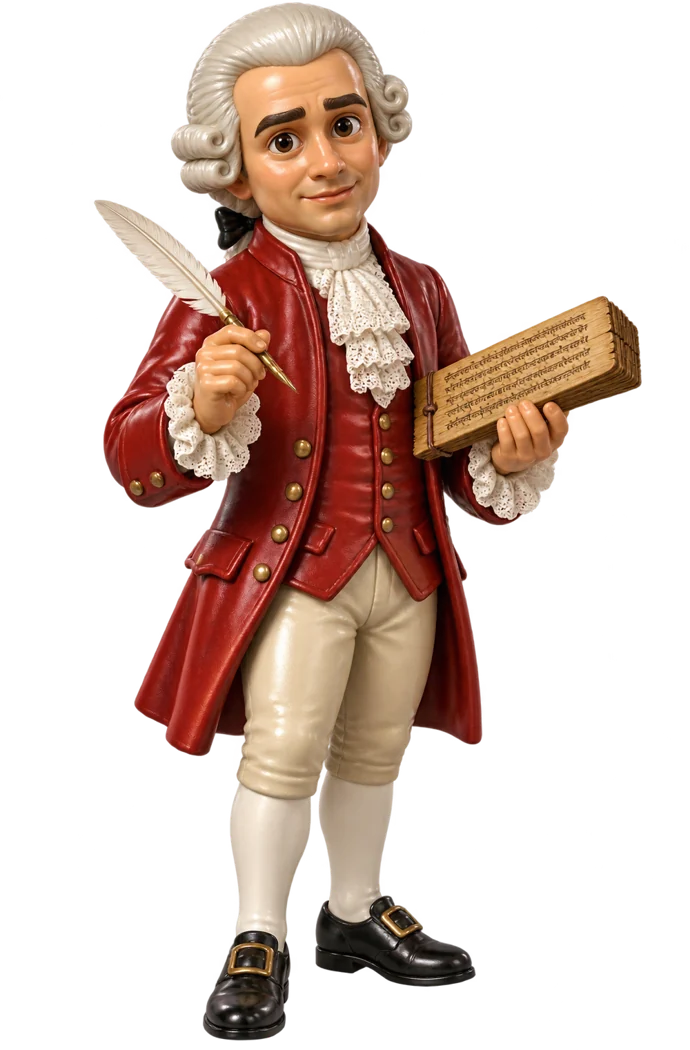
Early modern · person
William Jones
On 2 February 1786 a British judge in Calcutta told a learned society that Sanskrit, Greek and Latin must have sprung from one source "which, perhaps, no longer exists".
William Jones was born in Westminster on 28 September 1746, the son of the Welsh mathematician William Jones, who introduced the symbol π. His father died when he was three. At Harrow and University College, Oxford, he learned Greek, Latin, Persian, Arabic and Hebrew, and by 23 he was famous enough as an orientalist that King Christian VII of Denmark asked him to translate a Persian life of Nader Shah into French. He studied law at the Middle Temple, was elected a Fellow of the Royal Society in 1772 and backed American independence.
On 4 March 1783 he was appointed a judge of the Supreme Court at Fort William in Calcutta, and was knighted later that month. He married Anna Maria Shipley and reached Calcutta on 25 September 1783. On 15 January 1784 he founded the Asiatic Society. Unhappy with the court's pandits giving different rulings, he learned Sanskrit to read Hindu law for himself. In his third anniversary discourse to the Society, on 2 February 1786, he argued that Sanskrit, Greek and Latin, and perhaps Gothic, Celtic and Old Persian, came from a common source, an idea often taken as the start of Indo-European studies.
Over ten years he wrote on Hindu and Muslim law, music, botany and literature. He died in Calcutta on 27 April 1794, aged 47, and is buried in South Park Street Cemetery.
Read more on Wikipedia
Sources: en.wikipedia.org/wiki/William Jones (philologist), en.wikipedia.org/wiki/The Asiatic Society
