Middle Ages · state
Western Xia
The Tanguts wrote in a script of their own, printed books with movable type, and were wiped out in the campaign during which Genghis Khan died.
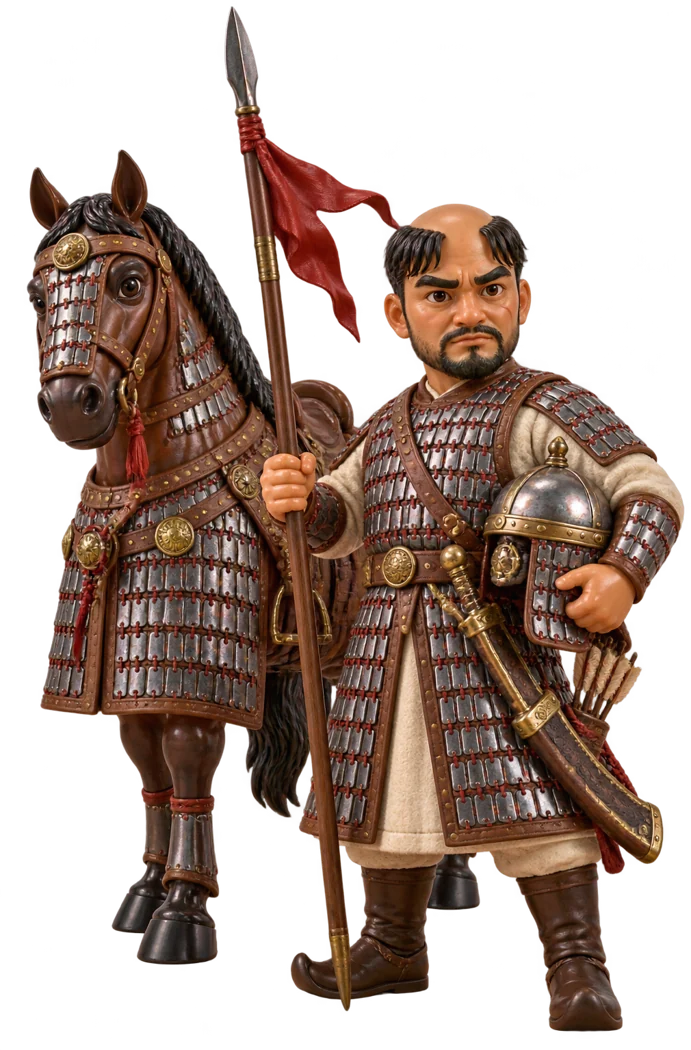
The Tanguts, a people speaking a Tibeto-Burman language, had ruled the region around Xiazhou in north-west China since Tang times. In the 1020s and 1030s Li Yuanhao conquered the Ganzhou Uyghur kingdom and called up every able man between 15 and 60, raising an army of 150,000. In 1034 he ordered his subjects to shave their heads and leave a fringe over the forehead and temples, and in 1038 he declared himself emperor of the Great Xia, with his capital at Xingqing, today's Yinchuan.
The state held the Hexi Corridor, the stretch of the Silk Road between northern China and Central Asia, and fought long wars with the Song and the Liao. Tangut, Chinese and Tibetan were all official languages, and the Tanguts wrote their own in a script made for it. Buddhism flourished, and the Tanguts pioneered printing with ceramic and wooden movable type. Emperor Renzong, who reigned from 1139 to 1193, set up schools across the country and built Confucian temples.
In the early 1200s the Mongols raided again and again, and in 1209 Genghis Khan himself invaded. In 1225 he attacked in force, and in 1227 he besieged the capital. He died that August, and his death was kept secret. In September Emperor Mo surrendered and was executed, and the Mongols slaughtered the city's people and plundered the imperial tombs.
Read more on Wikipedia
Sources: en.wikipedia.org/wiki/Western Xia, en.wikipedia.org/wiki/Western Xia tombs