Antiquity · state
Warring States period
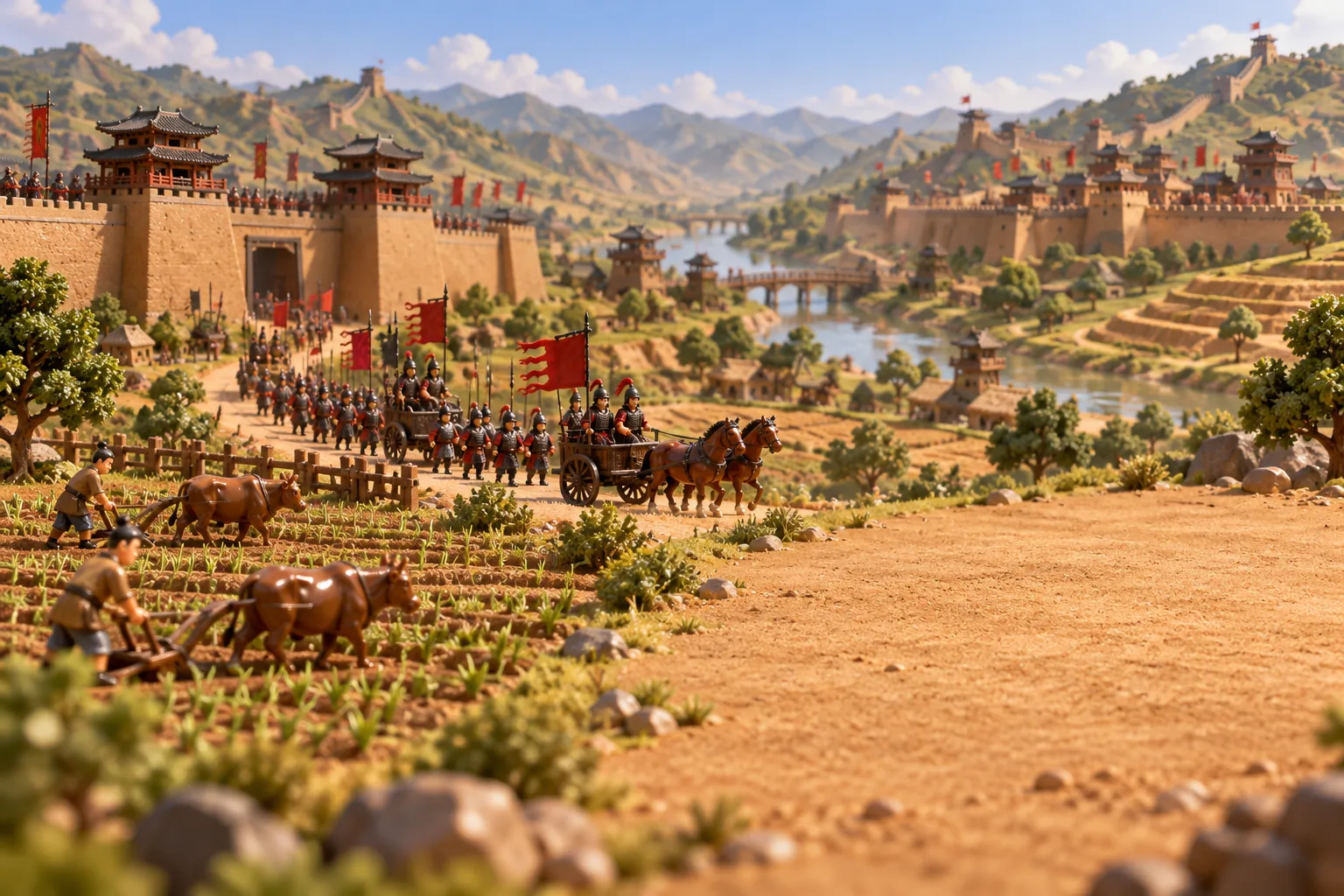
Seven kingdoms fought for some 250 years, and the winner, Qin, gave China its first emperor and probably its name.
The Zhou kings had long reigned only in name from their court near modern Luoyang. In 453 BC three clans of the great state of Jin, the Han, Wei and Zhao, destroyed the rival Zhi clan, and in 403 BC the Zhou court recognised them as marquises. Historians most often date the start of the period to 475 BC, following Sima Qian. Seven strong states emerged: Qin, Qi, Chu, Yan, Wei, Han and Zhao.
War grew to a new scale. Massed infantry with iron swords and crossbows replaced chariots, and in 307 BC King Wuling of Zhao formed the first Chinese cavalry unit. In Qin the minister Shang Yang created counties run by appointed magistrates, standard weights and measures and a harsh legal code. Thinkers of the Hundred Schools, among them Mencius, Mozi and Han Fei, argued over how to govern. In 325 BC the ruler of Qin declared himself king, and every state except Chu, which already had kings, followed. Qin crushed Zhao at Changping in 260 BC.
Qin ended the Zhou royal line in 256 BC. King Zheng then took the remaining states one by one: Han in 230 BC, Zhao in 228, Wei in 225, Chu in 223 and finally Qi. In 221 BC Zheng took the title of emperor as Qin Shi Huang, and the Warring States period was over.
Read more on Wikipedia
Sources: en.wikipedia.org/wiki/Warring States period, en.wikipedia.org/wiki/Battle of Changping, en.wikipedia.org/wiki/Names of China

