Our time · exploration
Voyager program
Two probes the weight of a small car, powered by about as much electricity as a few light bulbs, became the first human-made objects to leave the Sun's bubble.
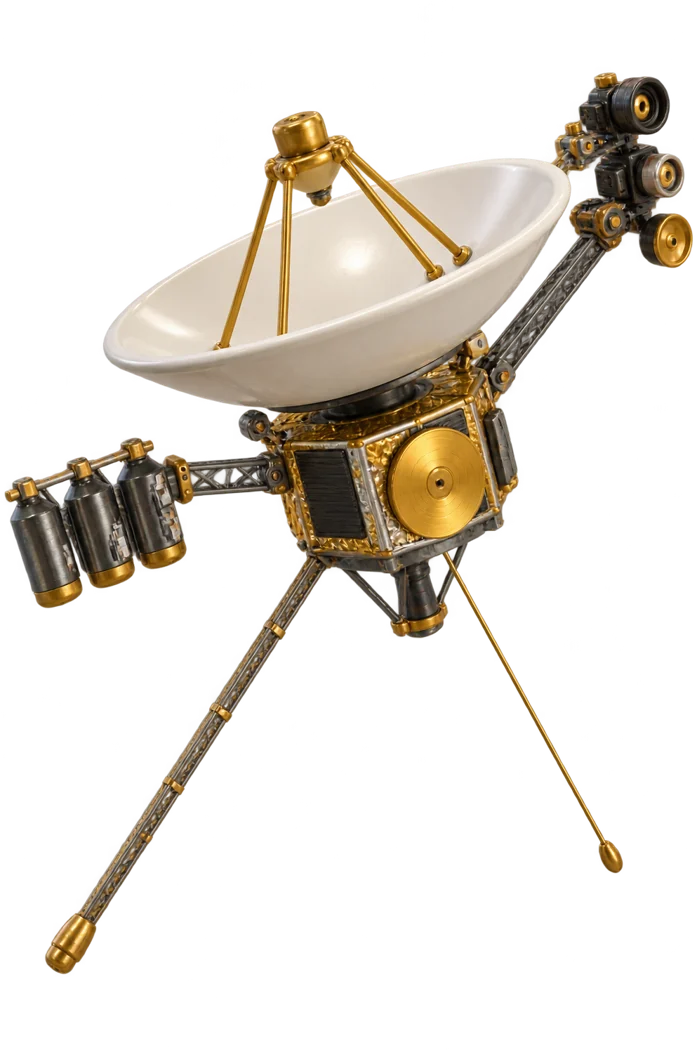
In 1964 the Jet Propulsion Laboratory engineer Gary Flandro noticed a rare line-up of the outer planets, which comes once every 175 years and would let one spacecraft swing from planet to planet using their gravity. NASA's grand tour was cancelled in 1971 to pay for the Space Shuttle, but a smaller mission of two identical probes survived. Each weighed 815 kilograms and ran on three generators powered by plutonium-238. In 1977 they were renamed Voyager.
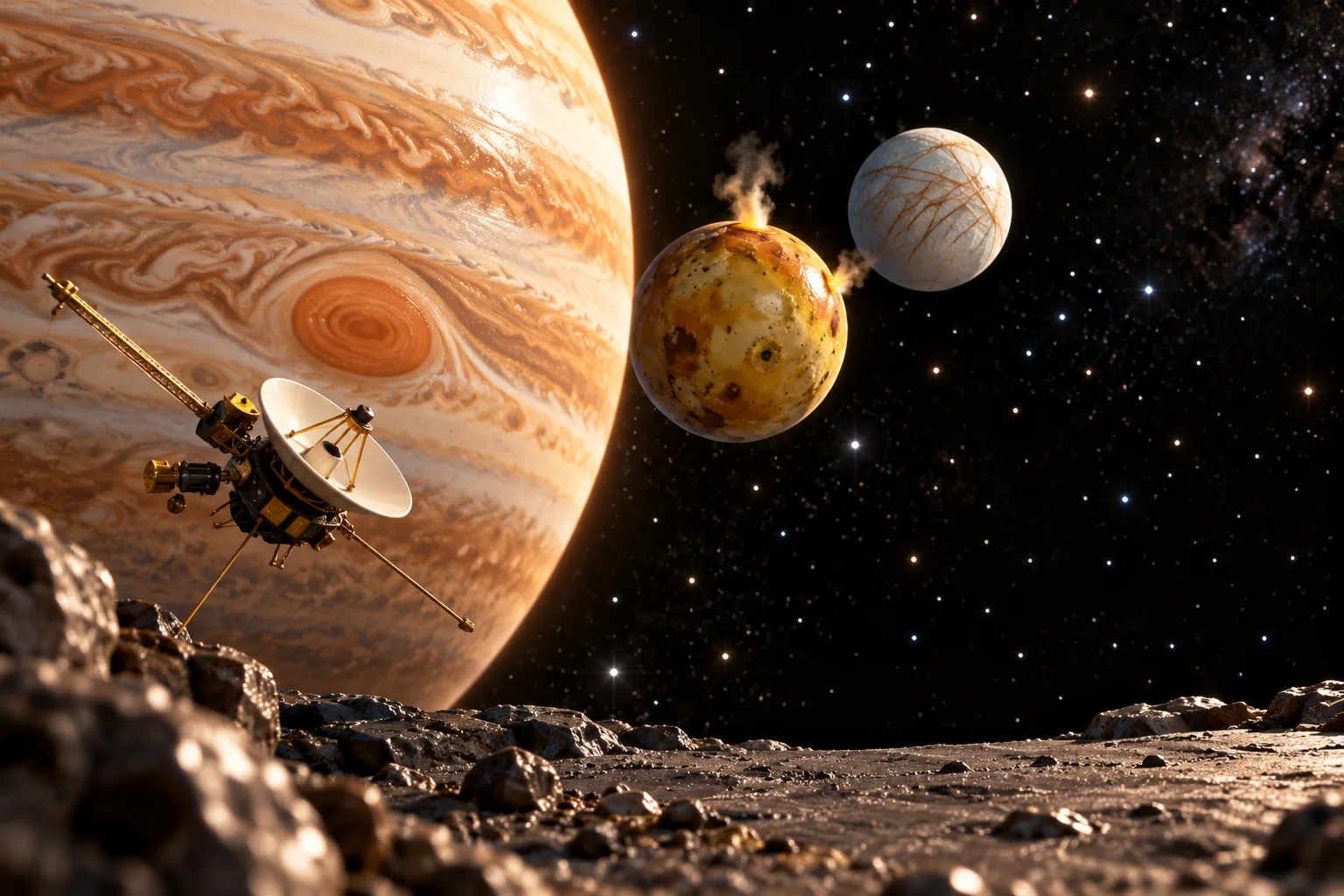
Voyager 2 was launched first, on 20 August 1977, and Voyager 1 followed on a shorter, faster path. Both flew past Jupiter and Saturn, sending back the first detailed colour pictures of their storms, rings and moons. Voyager 1 then swung close to Saturn's hazy moon Titan, which threw it out of the plane of the planets. Voyager 2 carried on and is still the only spacecraft to visit Uranus and Neptune.
On 14 February 1990, about 6 billion kilometres away, Voyager 1 turned its camera back and photographed Earth as a tiny speck, the Pale Blue Dot. In the 1990s it overtook Pioneer 10 to become the most distant human-made object. In December 2004 it crossed the termination shock, where the solar wind slows down, and on 25 August 2012 it passed the heliopause and became the first spacecraft in interstellar space.
Read more on Wikipedia