
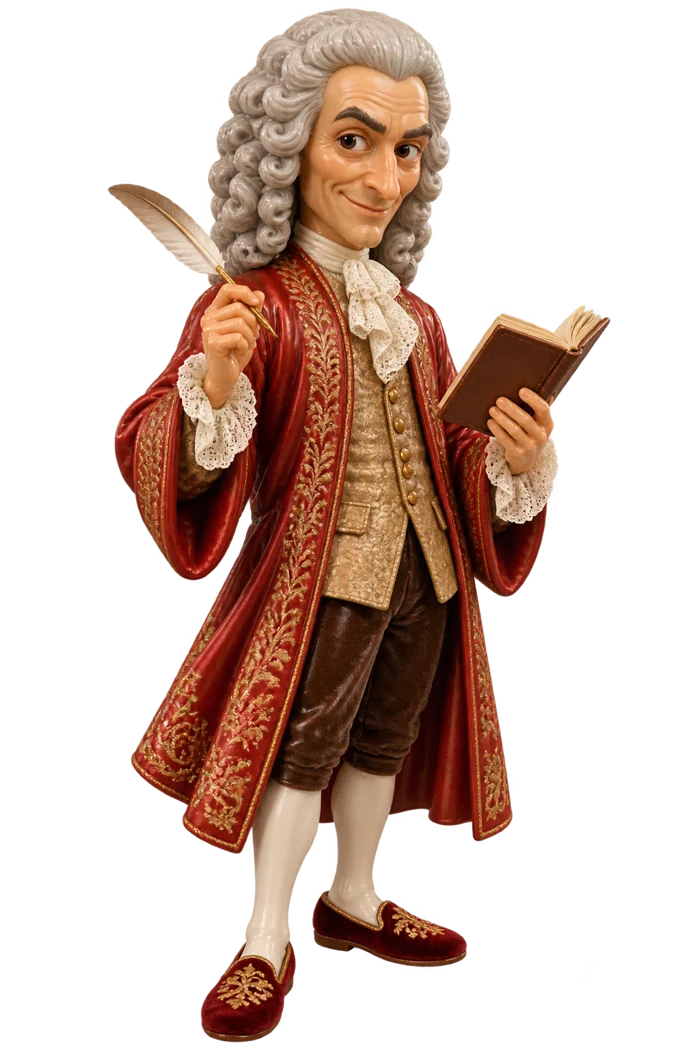
Early modern · person
Voltaire
Banned from Paris, he settled on an estate outside Geneva and in 1759 published Candide, a short, savage comedy that mocked the idea that all is for the best in the best of all possible worlds.
François-Marie Arouet was born in Paris on 21 November 1694, the youngest of five children of a lawyer and minor treasury official. The Jesuits of the Collège Louis-le-Grand taught him Latin and rhetoric. A satirical verse about the Regent earned him eleven months in the Bastille, and after his release his tragedy Œdipe (1718) made him famous; that year he took the name Voltaire, probably an anagram of his Latinised surname.
In 1726 a quarrel with the nobleman Rohan, whose servants beat him, landed him in the Bastille again, and he chose exile in England. There he met Pope, Swift and Gay, and came home an admirer of English liberty, commerce and Newton. He grew rich from a scheme to buy up a government lottery, and for 16 years lived with the mathematician Émilie du Châtelet at her château of Cirey. In 1750 he moved to Potsdam at the invitation of Frederick the Great, but they fell out. Barred from Paris by Louis XV, he bought Les Délices outside Geneva in 1755 and an estate at Ferney, just inside France, in 1758. Candide appeared early in 1759.
From Ferney he campaigned against "l'infâme", the abuses of Church and state, and took up the case of Jean Calas, a Protestant merchant put to death on a false charge of killing his son; in 1765 Voltaire got the verdict overturned. In February 1778 he returned to Paris in triumph and died there on 30 May, aged 83. In 1791 the revolutionaries moved his remains to the Panthéon.
Read more on Wikipedia
Sources: en.wikipedia.org/wiki/Voltaire


