Middle Ages · exploration
Vikings in America
Grassy bumps that Newfoundland fishermen called the 'old Indian camp' turned out to be the houses of Europeans who reached America five centuries before Columbus.
Two Icelandic sagas written down in the 13th century tell how Norse Greenlanders, Leif Erikson among them, found a land to the west and called it Vinland. For a long time historians could only guess where it was. In 1960 George Decker, a resident of the fishing hamlet of L'Anse aux Meadows on the northern tip of Newfoundland, led the Norwegian explorer Helge Ingstad to a group of grassy mounds near the village.
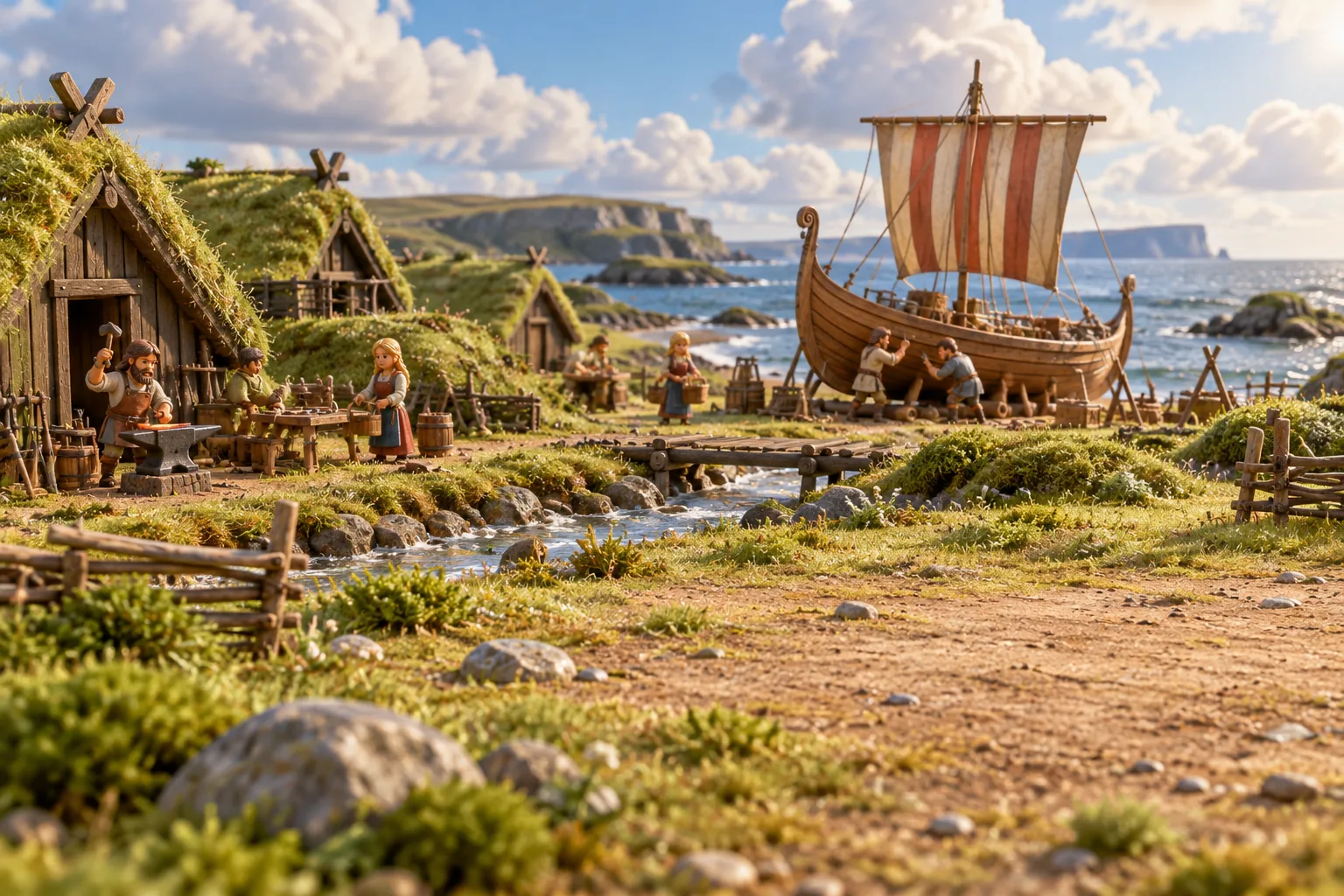
Helge Ingstad and the archaeologist Anne Stine Ingstad excavated there from 1961 to 1968. The mounds were the remains of eight buildings of sod laid over wooden frames: large houses, small huts, a carpentry workshop, a boat-repair area full of worn rivets and an iron smithy with a forge and slag. Among more than 800 Norse objects were a bronze pin, a stone oil lamp, a bone needle and part of a spindle, signs that women lived there as well as men. The houses could have held 30 to 160 people.
In 2021 scientists matched tree rings in wood from the site to a known spike in atmospheric radiocarbon in the year 993 and showed that the Norse were active there in 1021. L'Anse aux Meadows remains the only undisputed site of European contact with the Americas before Columbus outside Greenland. It was probably a base for exploring farther south rather than a colony, used on and off for perhaps 20 years, possibly longer, and then left in good order.
Read more on Wikipedia


