Early modern · state
Vijayanagara Empire
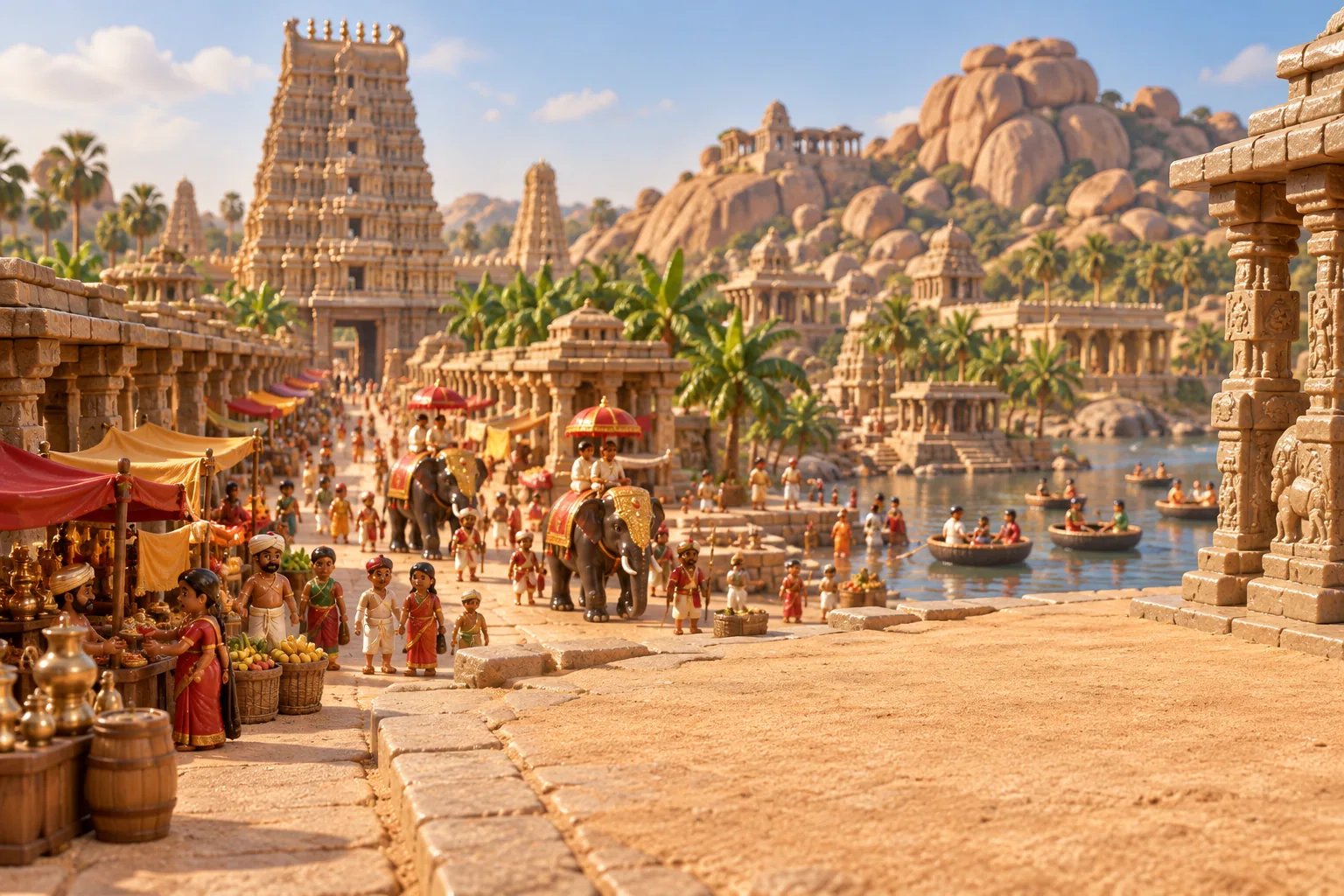
Its capital, which a Portuguese visitor called as large as Rome, was looted and burnt for six months after the Battle of Talikota in 1565 and never recovered.
In the early 14th century armies of the Delhi Sultanate raided and annexed the old Hindu kingdoms of the Deccan. In 1336 the brothers Harihara I and Bukka Raya I of the Sangama dynasty founded a new kingdom on the Tungabhadra River. Bukka moved the capital from Anegondi to Vijayanagara, the City of Victory. By 1374 he had beaten the Sultan of Madurai and taken Goa.
Wars with the Bahmani Sultanate went on for generations; a treaty of 1407 made Deva Raya I pay 100,000 huns, pearls and fifty elephants a year. The empire peaked under Krishnadevaraya, who reigned from 1509 to 1529. He took Raichur in 1520 and coastal lands from the Gajapatis of Odisha, and his army had 100,000 infantry, 20,000 cavalry and over 900 elephants. He also wrote the Telugu poem Amuktamalyada. The Portuguese Domingo Paes, who visited in 1520, found the capital as large as Rome, and by 1500 it was perhaps the second-largest city in the world after Beijing.
Rama Raya, Krishnadevaraya's son-in-law, later ruled in the name of a captive emperor. In January 1565 the Deccan sultanates united against him at Talikota. He was captured and beheaded, his army fled, and the capital was looted for six months and abandoned. The Aravidu dynasty ruled on from Penukonda, but the empire collapsed in 1614 and its last remnant ended in 1646.
Read more on Wikipedia
Sources: en.wikipedia.org/wiki/Vijayanagara Empire, en.wikipedia.org/wiki/Hampi


