
Industrial age · person
Utagawa Kuniyoshi
Broke and reduced to selling used tatami mats, a struggling print designer got his big chance in 1827: a series of tattooed outlaw heroes that took Edo by storm.
Utagawa Kuniyoshi was born on 1 January 1798, the son of a silk-dyer, Yanagiya Kichiyemon, and was first named Yoshisaburō. He probably helped in his father's business as a pattern designer, which may explain his rich colours and textile patterns. At 12 his drawing caught the eye of the great print master Utagawa Toyokuni, who took him into his studio in 1811. In 1814 he was given the name Kuniyoshi and set out on his own.
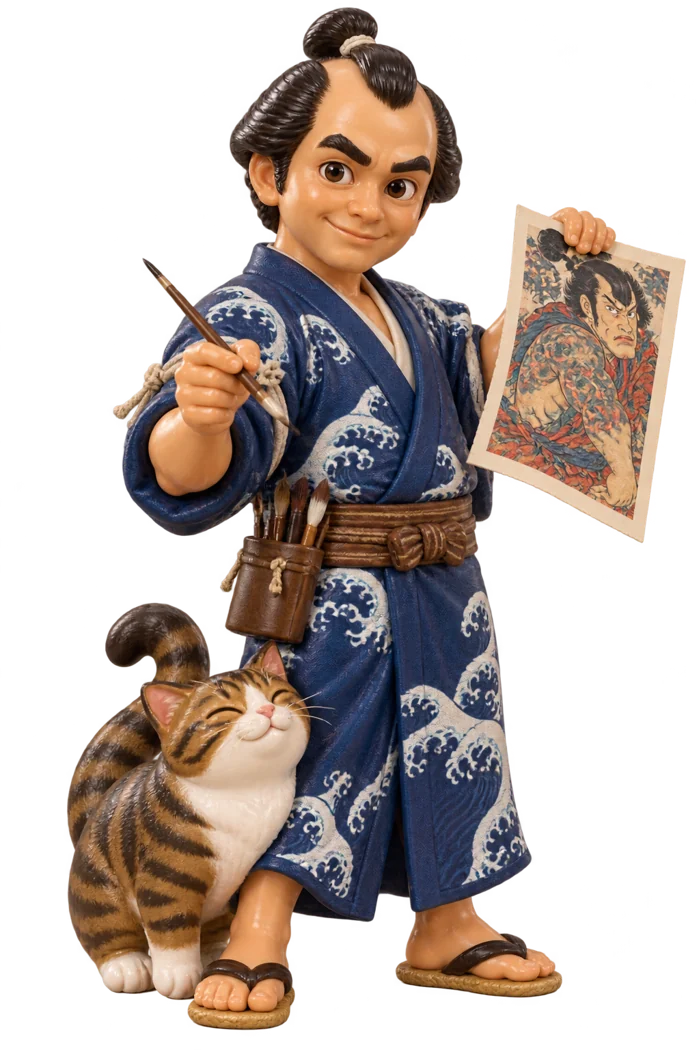
For years commissions were scarce, and at one point he was reduced to selling used tatami mats. In 1827 came his first major commission, a series of the 108 heroes of the Suikoden, the Chinese tale of the Water Margin. He drew each hero on his own sheet, covered in tattoos, a novelty that soon spread into Edo fashion, and the series made him famous. He went on to warrior prints full of ghosts, omens and superhuman feats, such as his 1839 triptych of Yoshitsune and Benkei on the Gōjō bridge, and landscapes using Western shading and perspective.
When the Tenpō Reforms of 1841–1843 banned pictures of courtesans and actors, he turned to comic prints that disguised them and quietly mocked the shogunate, often putting cats in place of people. He taught many pupils, above all Yoshitoshi, and died on 14 April 1861.
Read more on Wikipedia

