
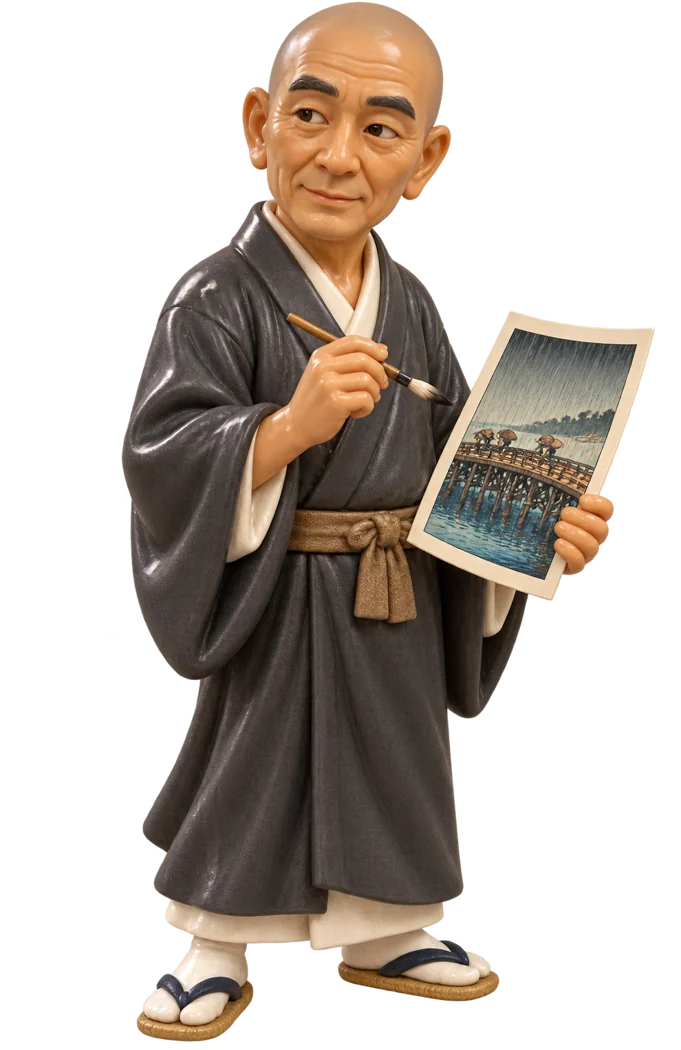
Industrial age · person
Utagawa Hiroshige
In his last years, now a Buddhist monk, he drew the city he was born in more than a hundred times, and in Paris, Vincent van Gogh copied him.
Andō Tokutarō was born in 1797 at Yayosu Quay in Edo, into a family of samurai background; his father was a fire warden at Edo Castle. Both his parents died in 1809, and the twelve-year-old inherited the fire warden's post, a duty that left him plenty of free time. He studied painting under Okajima Rinsai, was turned away by the busy master Toyokuni and became a pupil of Toyohiro of the Utagawa school, who by 1812 allowed him to sign as Hiroshige. His early prints showed beauties and kabuki actors.
Only around 1829–1830 did he turn to the landscapes and bird-and-flower prints that made his name. In 1832, as a fire warden with the privileges of a low-ranking samurai, he joined an official procession to Kyoto along the Tōkaidō road, sketching as he went, and back in Edo produced The Fifty-three Stations of the Tōkaidō. Many series followed, among them the Sixty-nine Stations of the Kisokaidō with Keisai Eisen. He used unusual viewpoints, seasons and weather, and colour gradations called bokashi. His first wife sold clothing and combs to pay for his sketching trips; after her death in 1838 he married Oyasu.
In 1856 he became a Buddhist monk and began One Hundred Famous Views of Edo, 118 sheets with huge objects thrust into the foreground. He died on 12 October 1858, during a cholera epidemic, aged 62, still in debt.
Read more on Wikipedia
Sources: en.wikipedia.org/wiki/Hiroshige


