Industrial age · politics
Treaty of Waitangi
A treaty was written in a few days by men who were not lawyers, translated overnight by a missionary, and its two versions still disagree about who holds power.
In the 1830s British settlers and traders were arriving in New Zealand, the New Zealand Company was planning a colony, and some Māori leaders had asked Britain for protection against French ambitions. In January 1840 Captain William Hobson arrived as consul. With no lawyers at hand, he wrote a treaty himself with his secretary and the British Resident, James Busby. On the night of 4 February the missionary Henry Williams and his son Edward translated it into Māori.
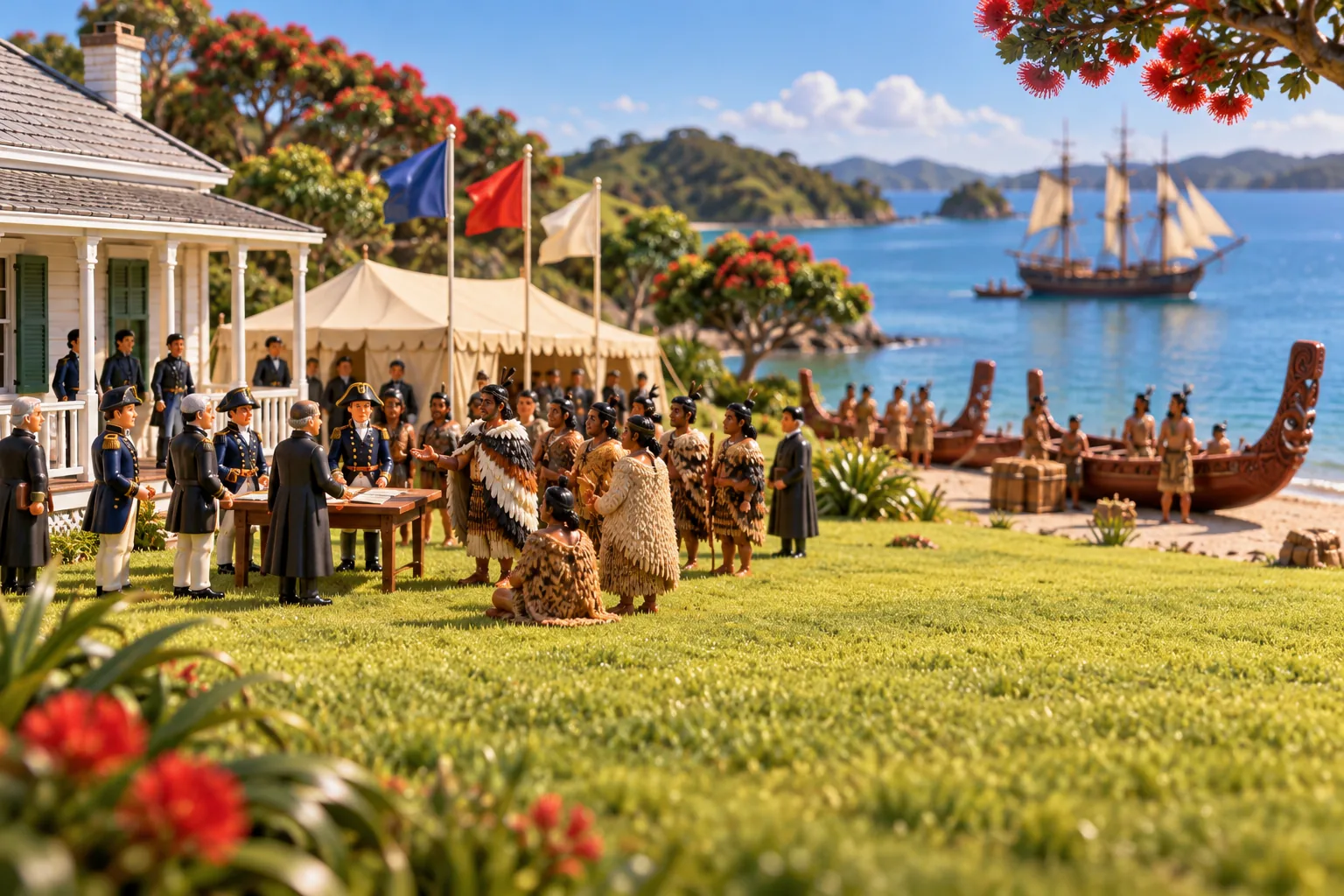
On 5 February the chiefs debated it in a marquee on the lawn of Busby's house at Waitangi, some urging caution, others such as Hōne Heke and Tāmati Wāka Nene speaking for the governor, and they went on talking late into the night. On 6 February the first chiefs signed. As each one signed, Hobson said "He iwi tahi tātou", "We are now one people". Copies were carried around the country, and in the following months about 530 to 540 Māori, at least 13 of them women, signed the Māori text; only 39 signed the English one.
The texts differ. In the English version the chiefs cede sovereignty; in the Māori text they grant kawanatanga, governance, while keeping rangatiratanga, full chieftainship, over their lands and treasures. The quarrel over what was agreed fed the New Zealand Wars of 1845 to 1872. In 1877 a court called the treaty "a simple nullity", but in 1975 Parliament set up the Waitangi Tribunal to investigate breaches of it.
Read more on Wikipedia

