
Prehistory · nature
Toba eruption
The largest known eruption of the last 2.6 million years dropped a layer of ash across all of India, and scientists still argue whether it nearly ended our species.
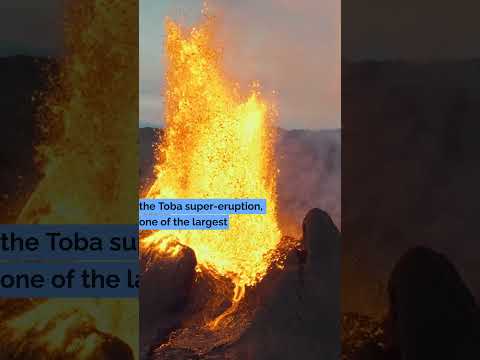
About 74,000 years ago, a volcano in northern Sumatra exploded in what was probably the largest eruption of the Quaternary period, the last 2.6 million years. It may have lasted only 9 to 14 days. The latest estimate is that it threw out about 3,800 cubic kilometres of rock: some 2,000 cubic kilometres poured over the ground as glowing flows of ash and pumice, and the rest rose into the sky, with a column reaching 32 km high. The empty magma chamber then collapsed, and the hole filled with water to become Lake Toba.
Ash fell in a layer about 5 cm thick across the Indian subcontinent and 10 cm deep in the central Indian Ocean. A blanket at least 1 cm thick covered more than 38 million square kilometres, about 7.5% of the Earth's surface. Microscopic glass shards from Toba have been found as far away as the south coast of South Africa, Ethiopia and Lake Malawi.
In the 1990s scientists proposed the Toba catastrophe theory: a volcanic winter lasting six to ten years, followed by a long cold spell, that pushed early humans through a severe genetic bottleneck. Later evidence has made many doubt it. At Jurreru Valley in southern India, stone tools lie both below and above a thick layer of Toba ash and look much the same, suggesting people there lived through it. Neanderthals and Denisovans survived too. Some researchers now consider the theory disproven, though the debate is not over.
Read more on Wikipedia