
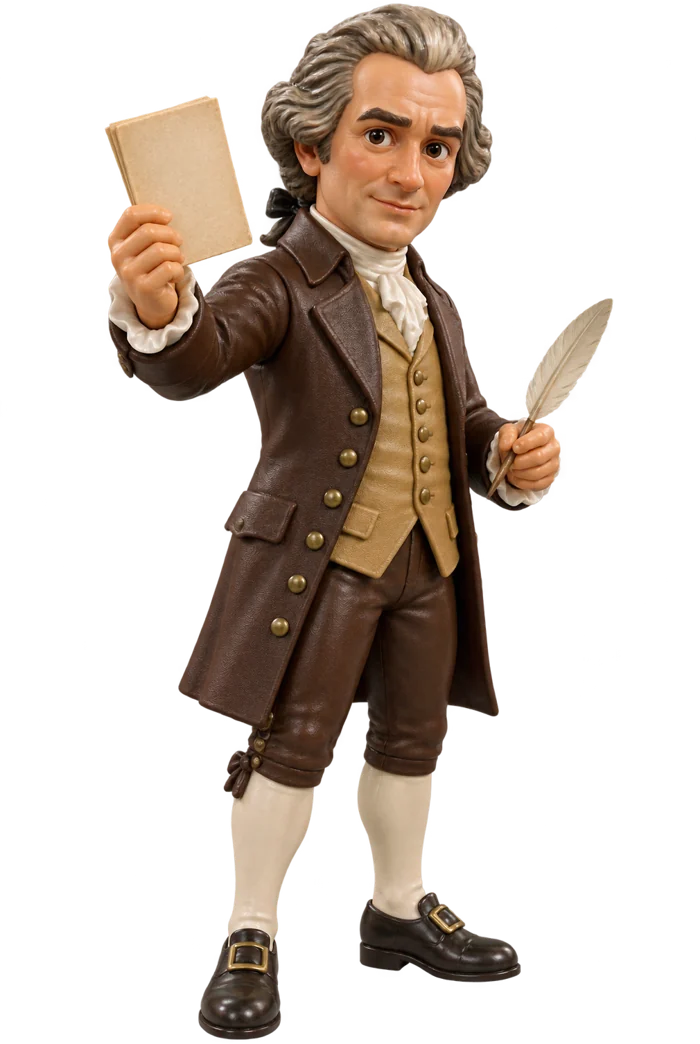
Early modern · person
Thomas Paine
In January 1776 an anonymous pamphlet "by an Englishman" went on sale in Philadelphia, and within three months some 100,000 colonists had bought its case for independence.
Thomas Pain, as the name was first spelled, was born on 9 February 1737 in Thetford, Norfolk, the son of a Quaker tenant farmer and staymaker. At 19 he served aboard a privateer, then set up as a master staymaker in Sandwich, Kent; his first wife, Mary Lambert, died in childbirth with their baby. He worked for years as an excise officer. In London in 1774 he was introduced to Benjamin Franklin, who helped him emigrate, and he reached Philadelphia so ill that he had to be carried off the ship.
On 10 January 1776 he published Common Sense, a 47-page pamphlet signed only "by an Englishman", which argued for independence from Britain in plain words. By his own estimate it sold 100,000 copies in three months among two million colonists. In late 1776 he began The American Crisis, and George Washington had the first issue read aloud to his soldiers: "These are the times that try men's souls."
His Rights of Man of 1791 answered Edmund Burke and defended the French Revolution. Charged with seditious libel in England, he fled to France in 1792 and was elected to the National Convention, though he spoke no French. Arrested in December 1793, he sat in the Luxembourg Prison until James Monroe won his release in November 1794. His attack on Christianity in The Age of Reason left him isolated after he returned to America in 1802. He died in Greenwich Village on 8 June 1809, aged 72, and only six mourners came to his funeral.
Read more on Wikipedia
Sources: en.wikipedia.org/wiki/Thomas Paine


