
Prehistory · science
The wheel
People farmed and made pottery for thousands of years before anyone thought to put a disc on an axle.
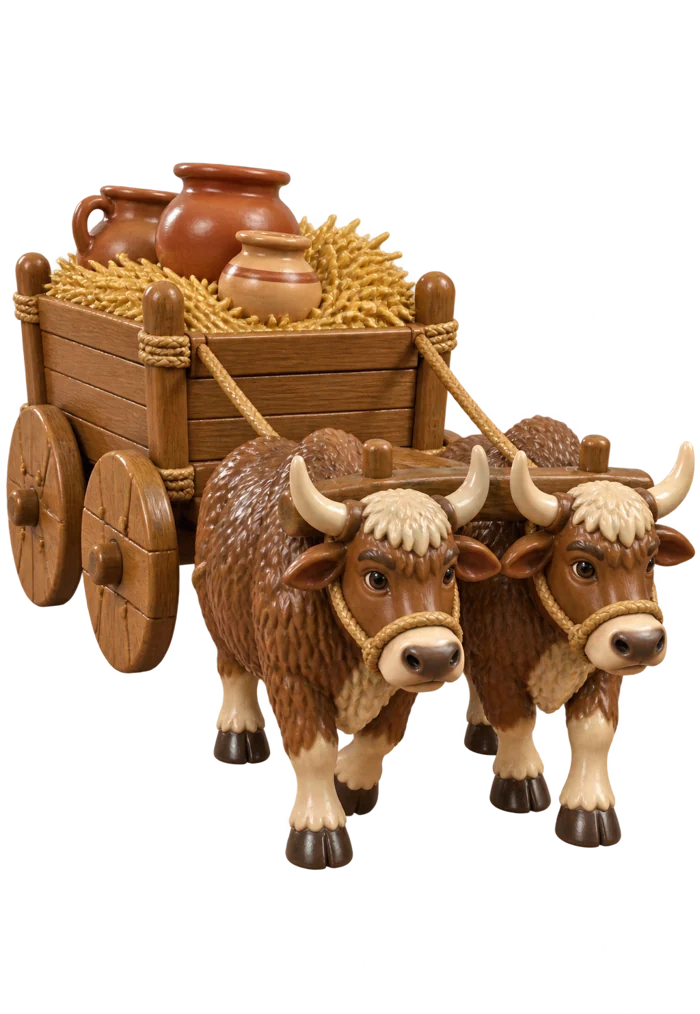
Wheels came surprisingly late. People had been farming and making pottery for millennia before the first solid wooden wheels, simple discs with a hole for the axle, appeared in the late Neolithic and Copper Age. They probably grew out of an older trick: rolling heavy loads on logs.
Where the idea started is still unclear, because the earliest evidence turns up across a wide area at almost the same time. Miniature clay wheels from north of the Black Sea are older than 4000 BC. At Uruk in Mesopotamia, pictographs on clay tablets show wheeled wagons around 3500–3350 BC, and a clay pot from Bronocice in southern Poland, made between 3631 and 3380 BC, carries a drawing of a wagon. In the second half of the 4th millennium BC wheeled vehicles appear in the Caucasus and eastern Europe too. The oldest surviving wheel with its axle, found in the marshes near Ljubljana in Slovenia, dates to around 3340–3030 BC.
Early wheels were solid and heavy; some were simply slices of tree trunk. Around 2000 BC the Sintashta culture of the steppes made the first known spoked wheels, light enough for fast horse-drawn war chariots, which spread west into Greece and east toward China. Wheel tracks in China date to around 2200 BC. After that the spoked wheel stayed much the same until wire spokes and pneumatic tyres arrived in the 1870s.
Read more on Wikipedia
Sources: en.wikipedia.org/wiki/Wheel