Middle Ages · state
Tang dynasty
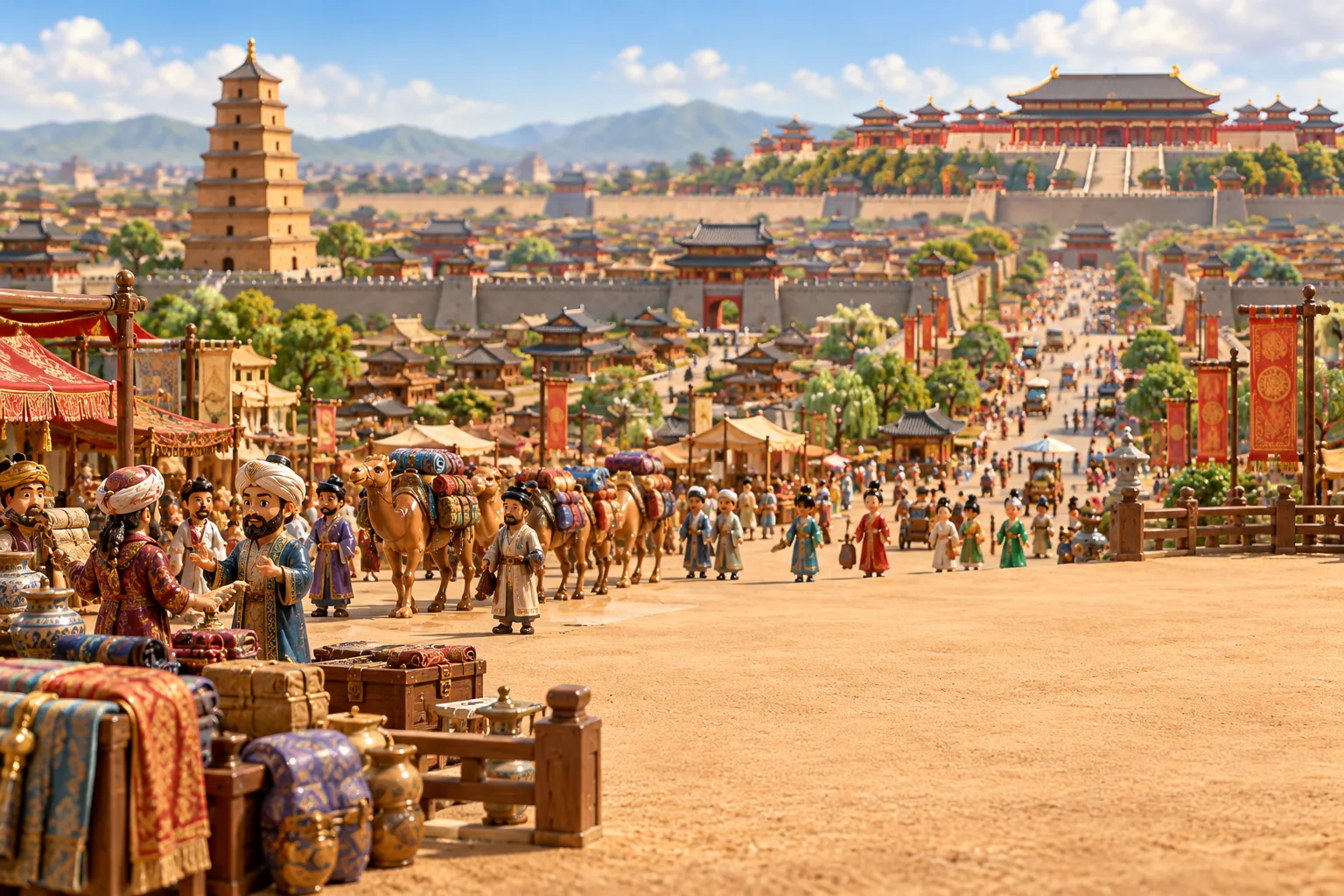
For three centuries the Tang capital was the biggest city in the world, where Silk Road merchants, Buddhist pilgrims and China's greatest poets crossed paths.
As the Sui dynasty collapsed, Li Yuan rose in rebellion in 617 and founded the Tang in 618, ruling from Chang'an, today's Xi'an. His son Li Shimin, known as Taizong, killed two of his brothers and pushed his father aside, yet became one of China's most admired emperors. After his victory over them, the Turks accepted him as their khagan, the Heavenly Khan.
Tang armies pushed deep into Central Asia along the Silk Road, and Chang'an was the world's most populous city for much of the dynasty. Officials were chosen through Confucian examinations. From 690 to 705 Wu Zetian ruled under her own Zhou dynasty, the only woman to be a legitimate emperor of China. Li Bai and Du Fu wrote in what is counted the greatest age of Chinese poetry, and the monk Xuanzang came back from a 17-year journey to India with Sanskrit texts.
The westward advance ended at the Battle of Talas in 751, and from 755 to 763 the rebellion of the general An Lushan devastated the north. Regional military governors called jiedushi grew ever stronger, and the rebellion of Huang Chao from 874 to 884 sacked both Chang'an and Luoyang. In 907 Zhu Wen, a former salt smuggler who had served under Huang Chao, deposed the last Tang emperor and took the throne himself.
Read more on Wikipedia
Sources: en.wikipedia.org/wiki/Tang dynasty


