Our time · politics
Surrender aboard USS Missouri
On a battleship's deck in Tokyo Bay, a ceremony lasting just 23 minutes formally ended the Second World War.
Emperor Hirohito had told his people over the radio on 15 August that Japan accepted the Allied terms. Someone still had to sign. The prime minister, a member of the imperial family, could not go, and Prince Konoe refused. In the end Foreign Minister Mamoru Shigemitsu and General Yoshijirō Umezu, chief of the Army General Staff, agreed after a personal appeal from the Emperor. Early on 2 September eleven Japanese delegates were driven to Yokohama and taken out to the battleship USS Missouri, anchored in Tokyo Bay. They came in morning dress and full dress uniform. Douglas MacArthur refused to let the Allies match them: "We fought them in our khaki uniforms, and we'll accept their surrender in our khaki uniforms."
At 9:04 Shigemitsu signed on behalf of the Emperor and the government, and two minutes later Umezu signed for the armed forces. MacArthur signed as Supreme Commander for the Allied Powers, followed by Admiral Chester Nimitz for the United States and by representatives of China, Britain, the Soviet Union, Australia, Canada, France, the Netherlands and New Zealand. At 9:25 the war was officially over.
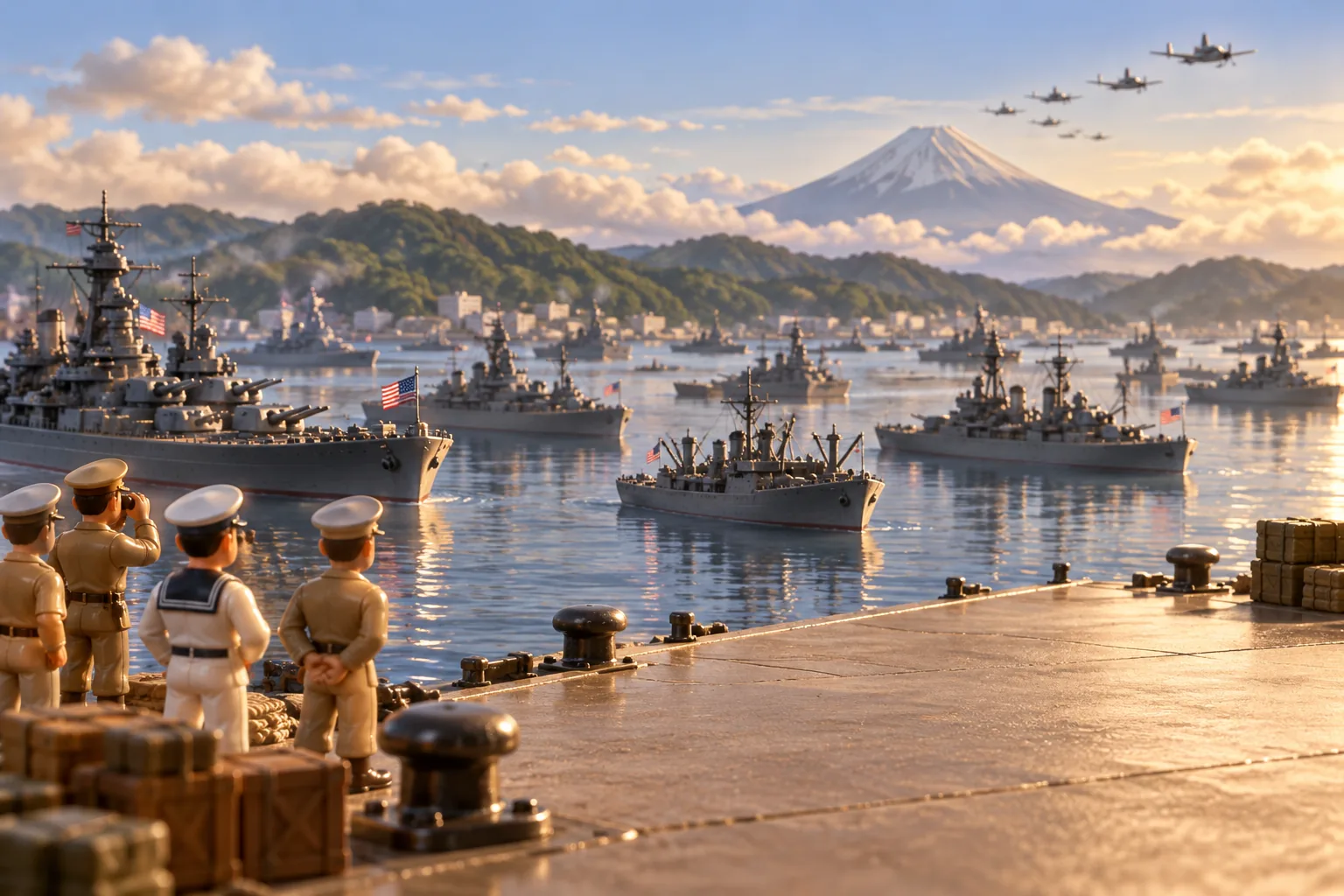
Ships and planes patrolled offshore in case of a kamikaze attack, which never came. The ceremony ended with more than 800 aircraft, 462 of them B-29 bombers, roaring over the bay. Above the deck hung the flag that Commodore Matthew Perry had flown in 1853, when his warships forced Japan to open its ports.
Read more on Wikipedia
Sources: en.wikipedia.org/wiki/USS Missouri (BB-63), en.wikipedia.org/wiki/Japanese Instrument of Surrender, en.wikipedia.org/wiki/Surrender of Japan

