Middle Ages · state
Sui dynasty
It reunited China after a long age of division and dug the Grand Canal, then collapsed after only 37 years.
In 581 Yang Jian, a general and regent at the Northern Zhou court in northern China, took the throne from a child emperor and became Emperor Wen of Sui. In a bloody purge he had 59 Zhou princes killed. In 588 he massed 518,000 troops along the north bank of the Yangtze, and in 589 his army entered Jiankang, now Nanjing. The last Chen emperor surrendered, and China was one state again.
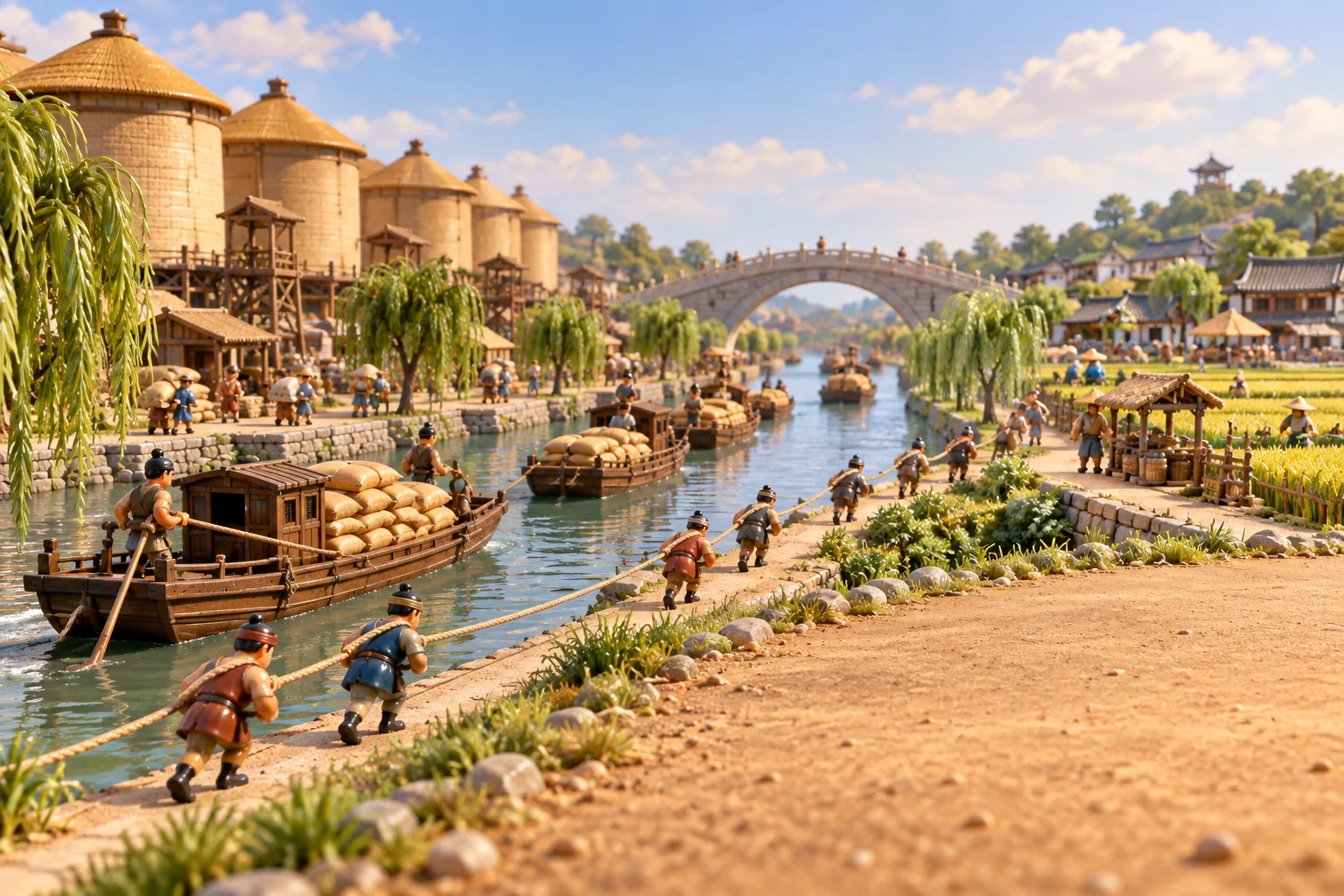
Wen built state granaries, used the equal-field system to share out farmland and reunified the coinage. The population grew to a peak not passed until the Tang emperor Xuanzong more than a century later. His son Emperor Yang moved the capital to a rebuilt Luoyang in 605 and greatly enlarged the Grand Canal, which linked Luoyang and Chang'an with Jiangdu, Yuhang and the northern frontier near modern Beijing. Millions of conscripted workers dug the canal and extended the Great Wall, and Sui armies retook the Hanoi area in 602.
Emperor Yang then sent huge armies against the Korean kingdom of Goguryeo; one force counted up to 1.15 million infantry and over 3,000 warships. All four campaigns failed, and revolts spread across the empire. Yang went south and was killed by his Yuwen clan advisers in 618. In the north the aristocrat Li Yuan took the throne as Emperor Gaozu, founding the Tang dynasty.
Read more on Wikipedia
Sources: en.wikipedia.org/wiki/Sui dynasty