Industrial age · politics
Straits Settlements
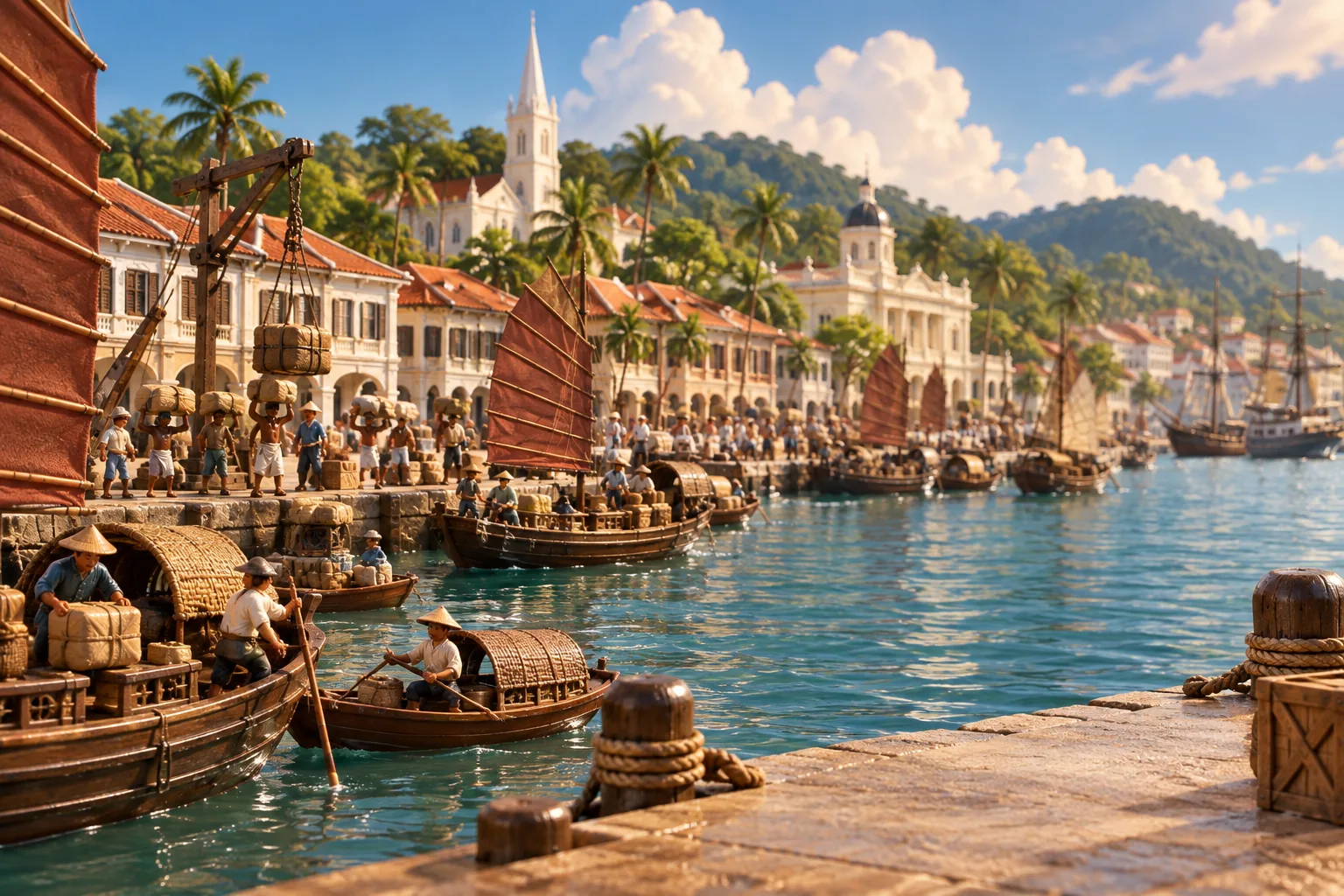
Three port towns strung along one of the world's busiest sea lanes were ruled as a single colony for 120 years, and one of them became Singapore.
Britain's first foothold on the Malay Peninsula was Penang, taken in 1786 by the East India Company; the strip of mainland opposite, Province Wellesley, was added from 1800. In 1819 Stamford Raffles founded a trading post at Singapore, and in the Anglo-Dutch Treaty of 1824 the Dutch handed over Malacca and gave up their claims to Singapore in exchange for the British settlement of Bencoolen on Sumatra. In 1826 the East India Company joined Penang, Malacca and Singapore into the Straits Settlements, and in 1832 the capital moved from George Town to Singapore.
The settlements were busy free ports, and their people were mostly Chinese immigrants, with Malays, Tamils and a tiny but powerful European minority. Under the Company they also served as penal colonies for Indian prisoners, the "Botany Bays of India". In 1858 they passed to the government of British India, and on 1 April 1867 they became a Crown colony ruled directly from London. Its governor was also high commissioner for the Malay states on the peninsula and for British territories in Borneo. The population grew from 306,775 in 1871 to 572,249 in 1901, almost all of it through immigration.
Japan invaded in December 1941. Penang fell on 16 December, Malacca on 15 January 1942 and Singapore on 15 February 1942. After the war the colony was dissolved on 1 April 1946: Singapore became a separate colony, while Penang and Malacca joined the Malayan Union.
Read more on Wikipedia
