Our time · person
Stephen Hawking
Unable to speak and steering a computer with one hand switch, he finished a book on the universe that stayed on the Sunday Times bestseller list for 237 weeks.
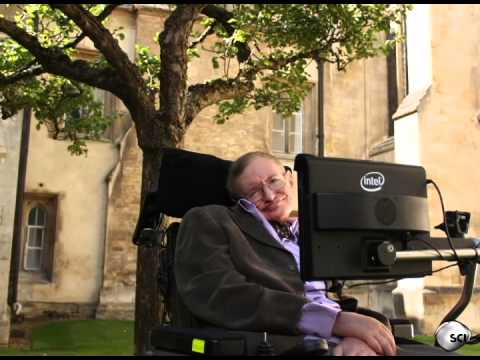
Stephen William Hawking was born in Oxford on 8 January 1942 to Frank and Isobel Hawking, who had both studied at Oxford University. At 17 he went to University College, Oxford, to read physics, and in 1962 he began graduate work at Trinity Hall, Cambridge. A year later, aged 21, he was diagnosed with a slow form of motor neurone disease that would paralyse him over decades. A first forecast gave him only two years to live. He sank into depression, but in 1965 he married Jane Wilde, whom he had met at a party.
Inspired by Roger Penrose's work on the singularity at the centre of black holes, Hawking applied the same idea to the whole universe in his thesis. In 1974 he argued that black holes are not entirely black but give off radiation, now called Hawking radiation, and the same year he became one of the youngest Fellows of the Royal Society. From 1979 to 2009 he held the Lucasian chair of mathematics at Cambridge. He wanted to explain cosmology to everyone, signed with the mass-market publisher Bantam Books. After losing his speech he talked through a speech-generating device. A Brief History of Time came out in April 1988 in the US and in June in Britain.
It topped bestseller lists on both sides of the Atlantic. Hawking became the most famous scientist of his age, lending his synthetic voice to a Pink Floyd song in 1993 and to The Simpsons in 1999, while he kept working on black holes and the origin of the universe.
Read more on Wikipedia