
Middle Ages · state
Srivijaya
This Sumatran sea power controlled the Strait of Malacca, and the Chinese monk Yijing stayed there for six months in 671.
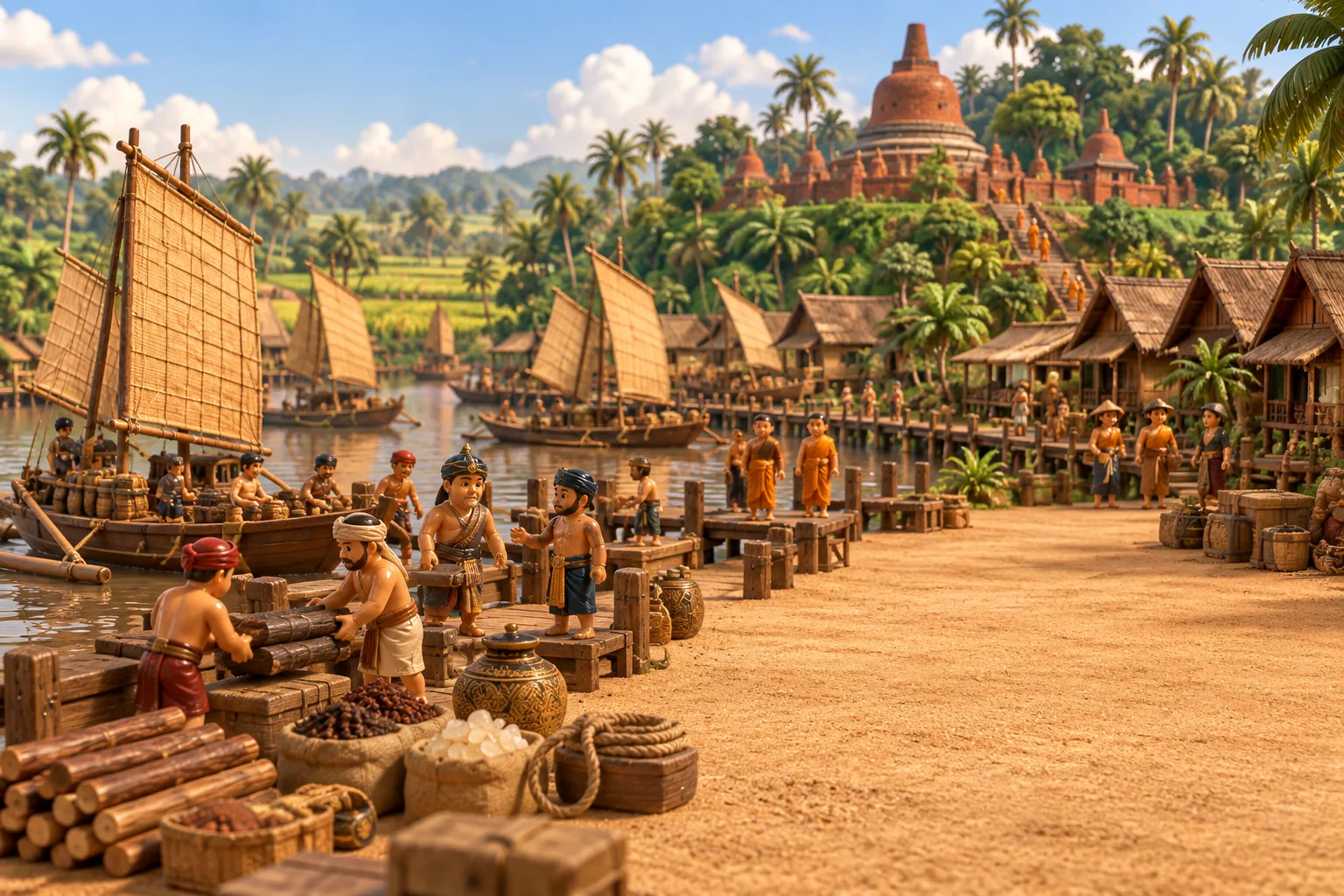
Srivijaya, a Sanskrit name meaning roughly 'shining victory', rose in the 7th century on the Musi River in south-eastern Sumatra, near today's Palembang. The Kedukan Bukit inscription, dated 16 June 682 and written in Old Malay in a Pallava script, is the earliest known stone to carry its name. Its kings grew rich not on land but on the sea: they controlled both passages between India and China, the Sunda Strait and the Strait of Malacca.
Srivijaya was also a great centre of Buddhism, where, Chinese sources say, thousands of monks lived. The Chinese monk Yijing stayed there for six months in 671 on his way to study at Nalanda in India, and came back again in 695. In the second half of the eighth century the Srivijayan realm seems to have been ruled by the Sailendra dynasty of Central Java, the builders of Borobudur, and Arab writers described its kings as masters of vast armies and tens of thousands of elephants.
In 1025 the Chola Empire of southern India launched several major raids on its ports, and the kingdom may have broken up after them. After Singhasari attacked Malayu in 1275, many small Malay port-states rose along the strait. Srivijaya was then forgotten, and only in 1918 did the French historian George Cœdès argue that it had existed.
Read more on Wikipedia
Sources: en.wikipedia.org/wiki/Srivijaya