Ancient world · state
Spring and Autumn period
Named after a chronicle of the state of Lu, it was the age of Confucius, when the Zhou kings lost real power.
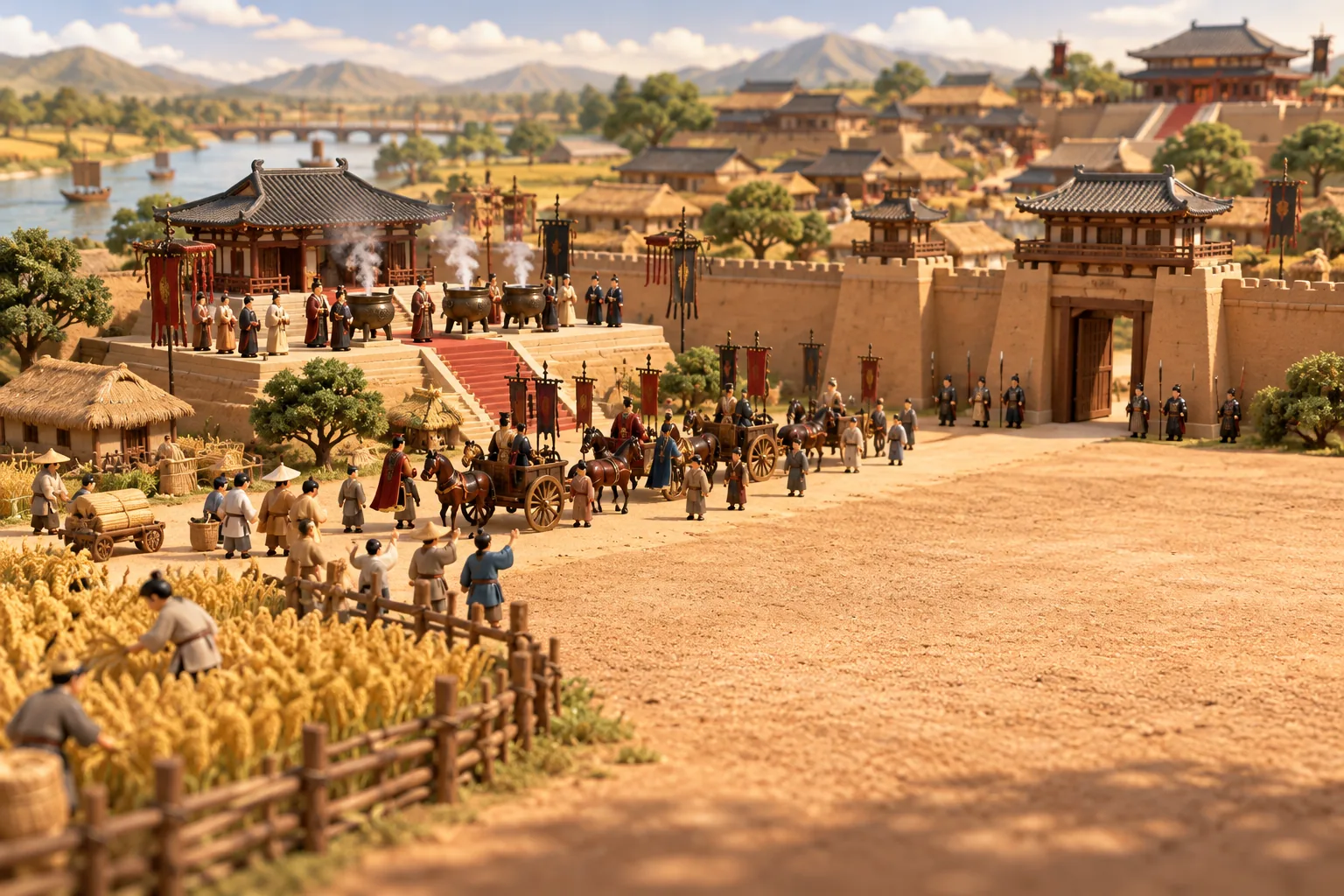
In 771 BC the Quanrong and their allies destroyed the Western Zhou capital at Hao, and the royal court moved east to Luoyi, near today's Luoyang. The Zhou kings kept their title and rituals but really controlled only a small royal domain. The land broke up into small states, mostly single walled cities: the chronicles name 148 states in this period, and by its end 128 of them had been swallowed by the four largest.
The period takes its name from the Spring and Autumn Annals, a chronicle of the state of Lu from 722 to 481 BC that tradition links with Confucius. Without royal order, rulers met at conferences, and the strongest was named hegemon, bound to protect the king and the smaller states. The first hegemon was Duke Huan of Qi, who ruled from 685 to 643 BC; Duke Wen of Jin won the title after beating Chu at Chengpu in 632 BC.
Confucius, born in Lu in 551 BC, became its acting prime minister in 499. In the south the states of Wu and Yue rose: King Helü of Wu attacked Chu with the help of Sun Tzu, the author of The Art of War, and his son Fuchai nearly destroyed Yue and imprisoned its king Goujian. The partition of Jin, completed in 403 BC, marks the start of the Warring States period.
Read more on Wikipedia