Early modern · state
Spanish Empire
A few hundred conquistadors and a mountain of silver made Spain the first empire on which, people said, the sun never set.
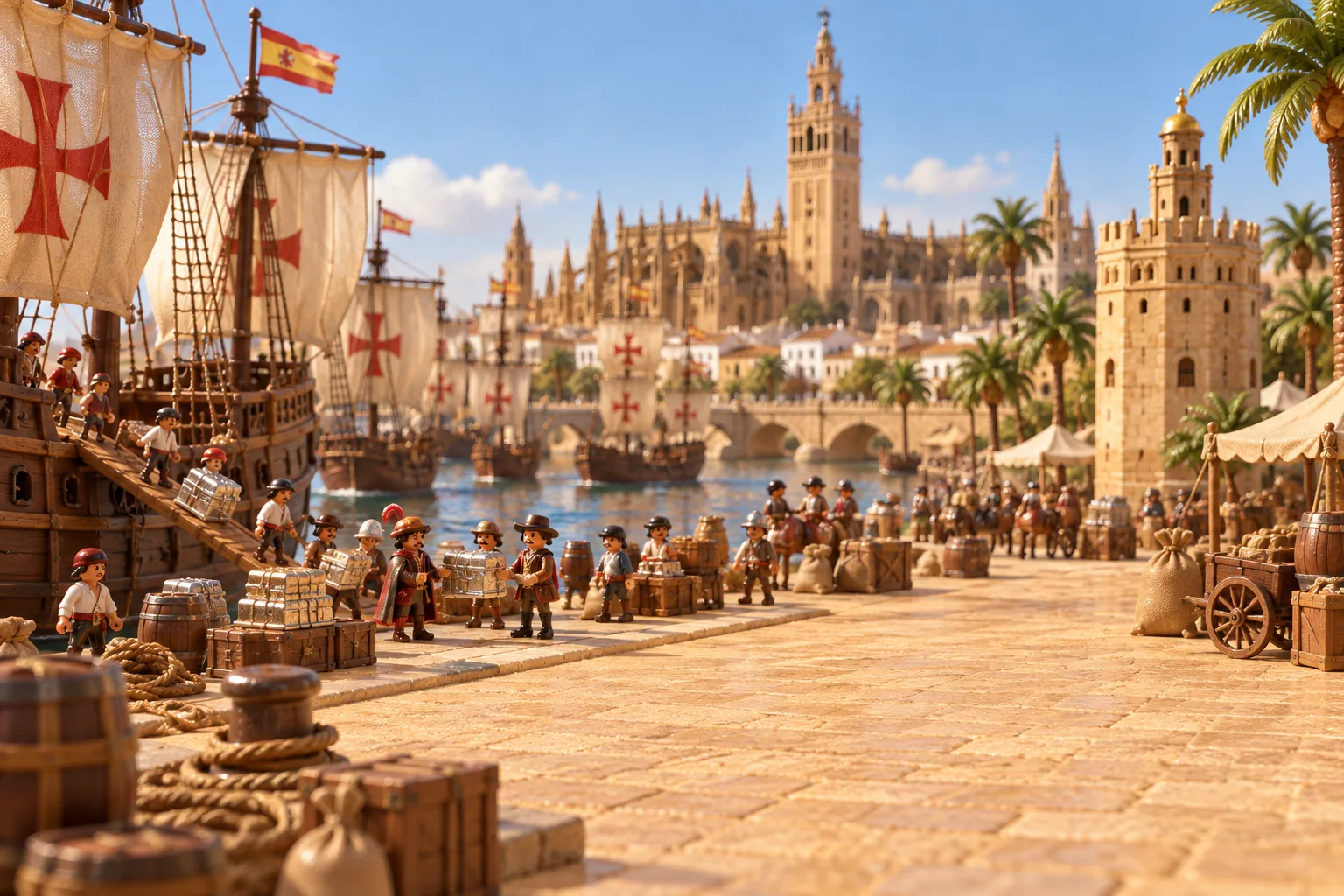
The empire began when Christopher Columbus, sailing for Isabella I of Castile and Ferdinand II of Aragon, reached the Caribbean in 1492. The Treaty of Tordesillas of 7 June 1494 split the newly found lands between Spain and Portugal. In 1516 the monarchs' Habsburg grandson Charles inherited Castile's Americas, southern Italy and the Low Countries. Hernán Cortés landed in Mexico with 550 men in 1519 and took the Aztec capital, and in 1532 Francisco Pizarro captured the Inca ruler Atahualpa at Cajamarca.
Silver from Potosí in today's Bolivia and from Zacatecas and Guanajuato in Mexico paid for Spain's wars in Europe. Fleets linked Seville, and later Cádiz, with Veracruz, Havana, Cartagena, Callao and Manila. Its realm became known as the empire on which the sun never sets. At its greatest extent, in the late 1700s and early 1800s, it covered 13.7 million square kilometres.
In 1700 the last Spanish Habsburg, Charles II, died without an heir and the Bourbon Philip V took the throne. Rivalry between Spaniards from Spain and Creoles born in the Americas fed the wars of independence, and by the mid-1820s Spain had lost Mexico, Central America and South America. Defeat by the United States in 1898 cost it Cuba, Puerto Rico, the Philippines and Guam, and its last African territories were given up in 1976.
Read more on Wikipedia
Sources: en.wikipedia.org/wiki/Spanish Empire, en.wikipedia.org/wiki/Treaty of Tordesillas

