Industrial age · war
Spanish–American War
A mysterious explosion in Havana harbour started a war that ended almost four centuries of the Spanish Empire in the Americas and Asia.
In 1895 Cuban nationalists rose against Spanish colonial rule. Spain answered harshly: General Valeriano Weyler, nicknamed "The Butcher", herded the rural population into camps under his reconcentration policy. American newspapers, competing for readers with sensational "yellow journalism", made the most of the atrocities, and public opinion swung behind the rebels. Presidents Grover Cleveland and William McKinley both resisted calls to intervene.
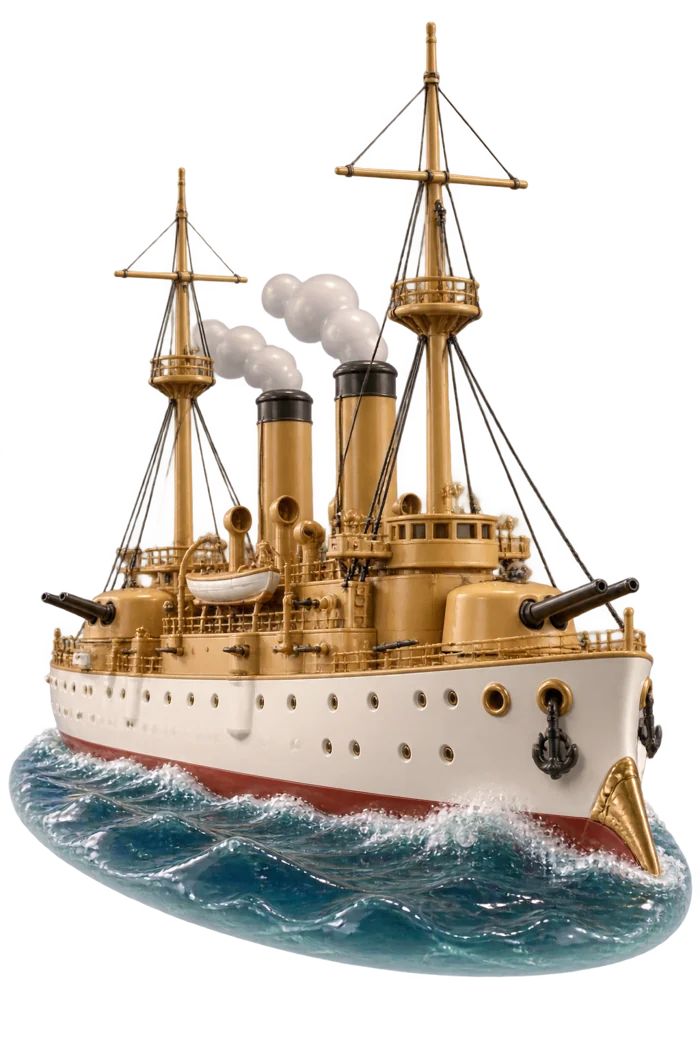
Then on 15 February 1898 the armoured cruiser USS Maine, sent to Havana to protect Americans there, was sunk by a mysterious explosion; 260 men died at once and six more soon after. "Remember the Maine, to hell with Spain!" ran the headlines, and McKinley got authority from Congress to use force. The war began in April. On 1 May Commodore George Dewey, aboard USS Olympia, destroyed a Spanish squadron in Manila Bay in the Philippines in a matter of hours. American troops landed in south-eastern Cuba in June and fought at El Caney and San Juan Hill on 1 July, where Theodore Roosevelt's volunteer Rough Riders became famous. On 3 July Admiral Cervera's squadron was destroyed off Santiago de Cuba, and the city surrendered on 17 July.
Fighting ended in August. In the Treaty of Paris, signed on 10 December 1898, Spain gave up Cuba and ceded Puerto Rico, Guam and the Philippines, for which the United States paid $20 million. The United States became a world power with island possessions across the globe.
Read more on Wikipedia


