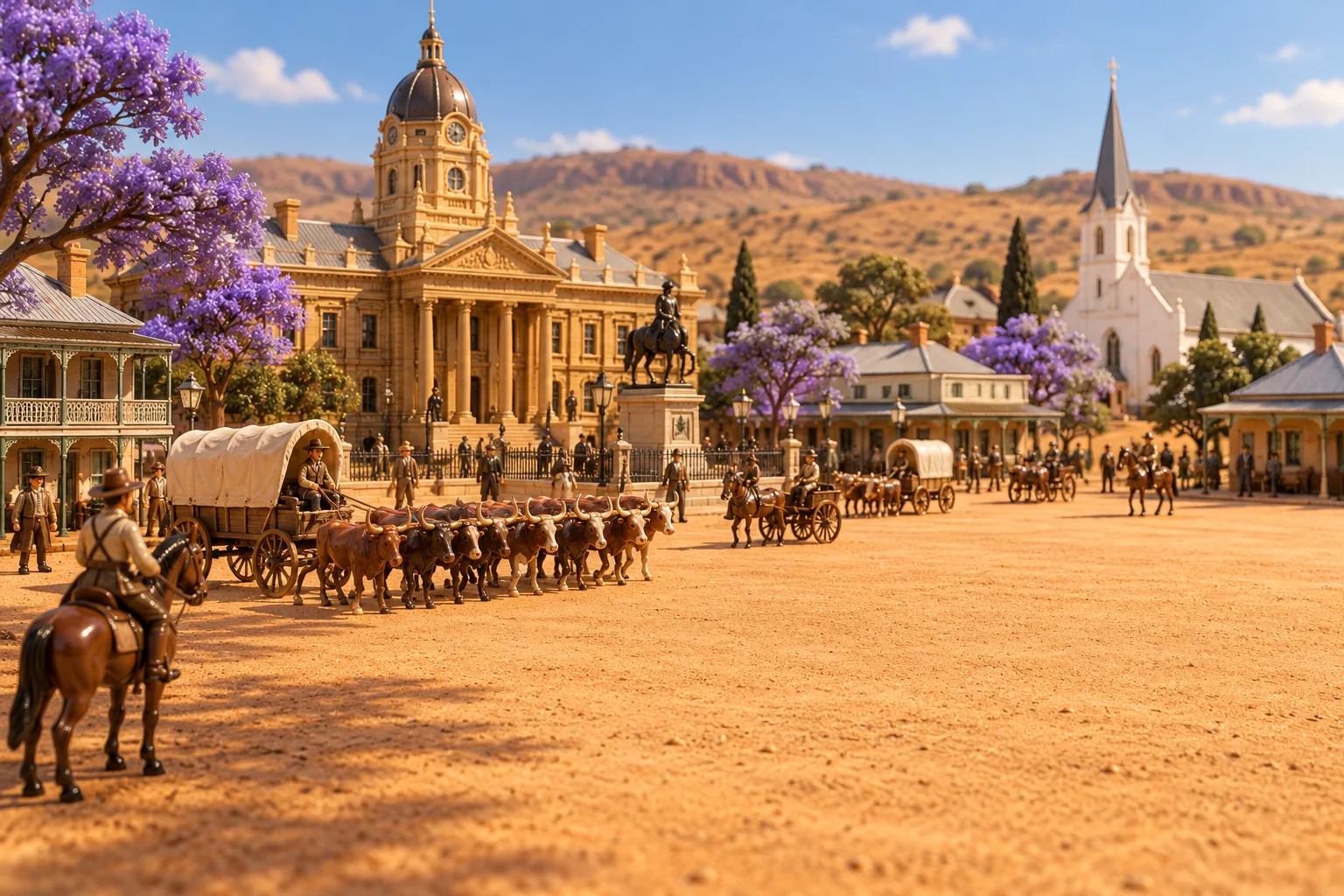

Industrial age · state
South African Republic
When gold was found on the Witwatersrand in the 1880s, this Boer republic sat on the world's richest goldfield, and Britain wanted it.
Boers who left the British Cape Colony in the Great Trek settled beyond the Vaal River. On 17 January 1852 the Sand River Convention recognised their independence, and the South African Republic, often called the Transvaal, was born. Its capital moved from Potchefstroom to Pretoria. On 12 April 1877, with the republic short of money and at war with the Bapedi, British officials led by Sir Theophilus Shepstone annexed it.
The Boers rose under a triumvirate of Paul Kruger, Piet Joubert and Marthinus Wessel Pretorius. They beat the British at Laing's Nek and Ingogo, and on 27 February 1881 at Majuba, where General Colley was killed. The republic regained self-rule under British suzerainty, and the London Convention of 1884 restored its old name. In 1885 rich gold reefs were found on the Witwatersrand, and the new city of Johannesburg rose on the veld. Foreign miners, the Uitlanders, poured in, and by 1897 immigrants had invested over 300 million pounds in the goldfields.
The Jameson Raid of December 1895 tried and failed to overthrow Kruger's government. War broke out again in 1899, and British forces occupied the republic, but many Boers fought on as guerrillas. Lord Kitchener answered with scorched earth and concentration camps. The Treaty of Vereeniging, signed on 31 May 1902, made the republic the British Transvaal Colony.
Read more on Wikipedia
Sources: en.wikipedia.org/wiki/South African Republic, en.wikipedia.org/wiki/Second Boer War