
Early modern · state
Songhai Empire
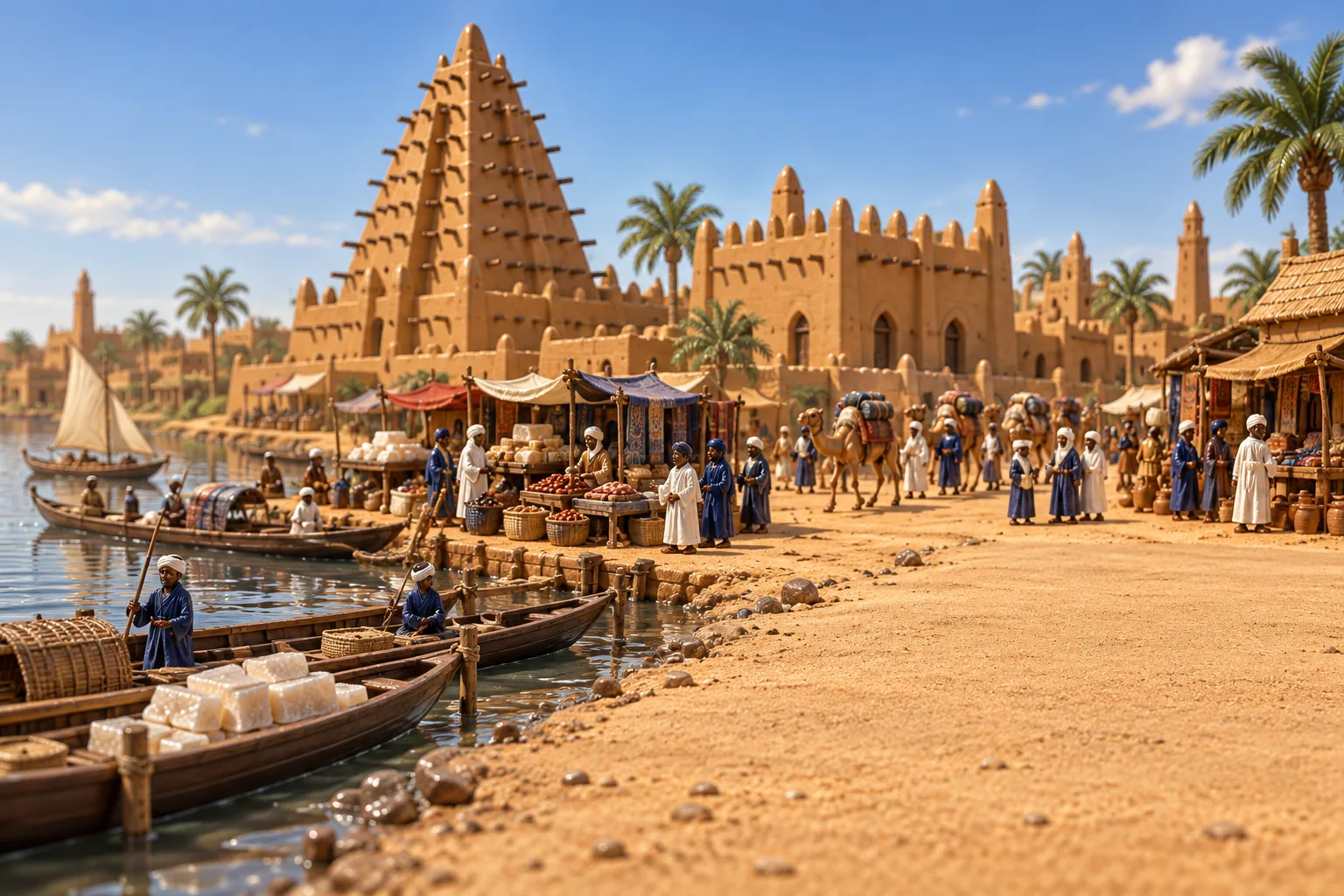
Under Askia Muhammad it ruled Timbuktu's scholars and the salt roads, until a Moroccan army with firearms crushed it in 1591.
A Songhai state had existed around Gao on the Niger since the 11th century, and the Mali Empire held the town for about a hundred years. As Mali weakened, the Songhai took Gao back. Sonni Ali, who reigned from 1464 to 1492, turned it into an empire: he annexed Timbuktu in 1468 and starved Djenné into surrender after a seven-year siege. Muslim chroniclers remembered him as a tyrant, because he honoured his people's old religion and persecuted the scholars of Timbuktu.
In 1493 one of his generals, Muhammad Ture, overthrew Sonni Ali's son and founded the Askia dynasty. Askia the Great kept a full-time army with cavalry and war canoes, set up a bureaucracy, standard weights and measures, and inspectors in the markets. He made the pilgrimage to Mecca and brought scholars from Egypt and Morocco to teach at the Sankore Mosque in Timbuktu. His empire took in the salt mines of Taghaza, deep in the Sahara.
After the death of Askia Daoud in 1583, a war of succession split the empire. The Moroccan sultan Ahmad al-Mansur sent an army under Judar Pasha across the Sahara, with thousands of arquebusiers and eight English cannons. In 1591 at Tondibi the much larger Songhai army was routed, and Gao, Timbuktu and Djenné were sacked.
Read more on Wikipedia
Sources: en.wikipedia.org/wiki/Songhai Empire, en.wikipedia.org/wiki/Battle of Tondibi


