
Industrial age · nature
Sinking of the Titanic
The Titanic carried lifeboats for barely half the people on board, and that was perfectly legal.
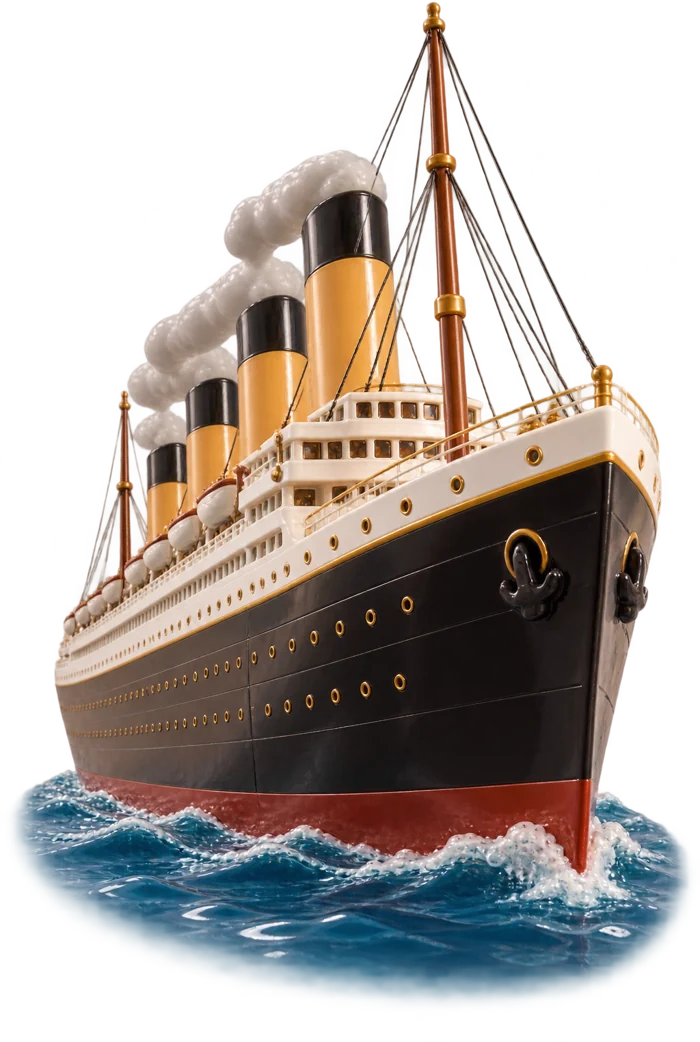
RMS Titanic left Southampton for New York on her maiden voyage in April 1912, the largest ocean liner in service, with more than 2,200 people on board. On the night of 14 April her wireless operators had already received seven warnings about ice, but she was steaming at about 22 knots, and her lookouts had no binoculars. At 23:40 the lookout rang the bridge: "Iceberg, right ahead!" The ship could not turn in time. The glancing blow buckled the plates along her starboard side and opened six of her sixteen compartments to the sea. She had been built to survive with four flooded.
The crew fired distress rockets and sent wireless calls for help while passengers were loaded into the boats. There were only twenty lifeboats, with room for 1,178 people. Many were launched before they were full: the evacuation was badly prepared, and many passengers refused to believe the danger or preferred the warmth inside to the bitter cold on deck. At 02:20 on 15 April, two hours and forty minutes after the collision, Titanic disappeared.
About 1,500 people died. Almost everyone who ended up in the water was killed within minutes by the cold. The liner Carpathia, 58 miles away, raced through the ice and picked up all 710 survivors by 09:15. The disaster led to the first International Convention for the Safety of Life at Sea and an International Ice Patrol. The wreck was found in 1985 by an expedition led by Robert Ballard.
Read more on Wikipedia