Ancient world · state
Shang dynasty
Shang kings put questions to their ancestors by cracking heated oracle bones, leaving behind the earliest known Chinese writing.
In the Annals of the Yin, the historian Sima Qian wrote that the dynasty began when Tang, a descendant of Xie, overthrew Jie, the cruel last king of the Xia, at the Battle of Mingtiao. Modern scholars place the Shang between the 16th and 11th centuries BC. Their Erligang culture, centred on a walled city at Zhengzhou, spread across a wide area, as far as the region of today's Beijing and the middle Yangtze, where Panlongcheng was a regional centre.
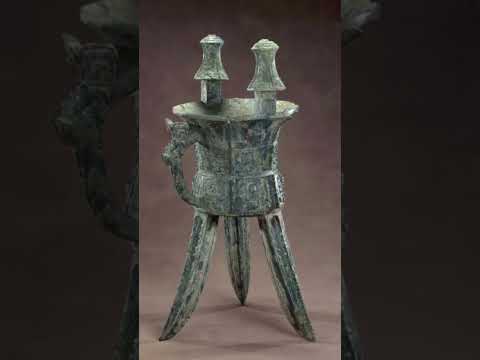
Sima Qian says the Shang moved their capital five times. The last move, to Yin under King Pan Geng, began the dynasty's golden age. Excavations at Yinxu near Anyang have uncovered eleven great royal tombs, palace foundations, the remains of humans and animals sacrificed in state rituals, and tens of thousands of objects in bronze, jade, stone, bone and clay. More than 20,000 oracle bones were dug up in the 1920s and 1930s alone, and four times as many since.
The last king, Di Xin, was remembered as depraved. At the bloody Battle of Muye, legends say, his own army and slaves went over to the Zhou rebels, and he killed himself. King Wu of Zhou let Di Xin's son Wu Geng rule the Shang as a vassal, and later a brother of Di Xin became Duke of Song at Shangqiu, where Shang rites lived on.
Read more on Wikipedia
Sources: en.wikipedia.org/wiki/Shang dynasty, en.wikipedia.org/wiki/Yinxu