Early modern · state
Sengoku period
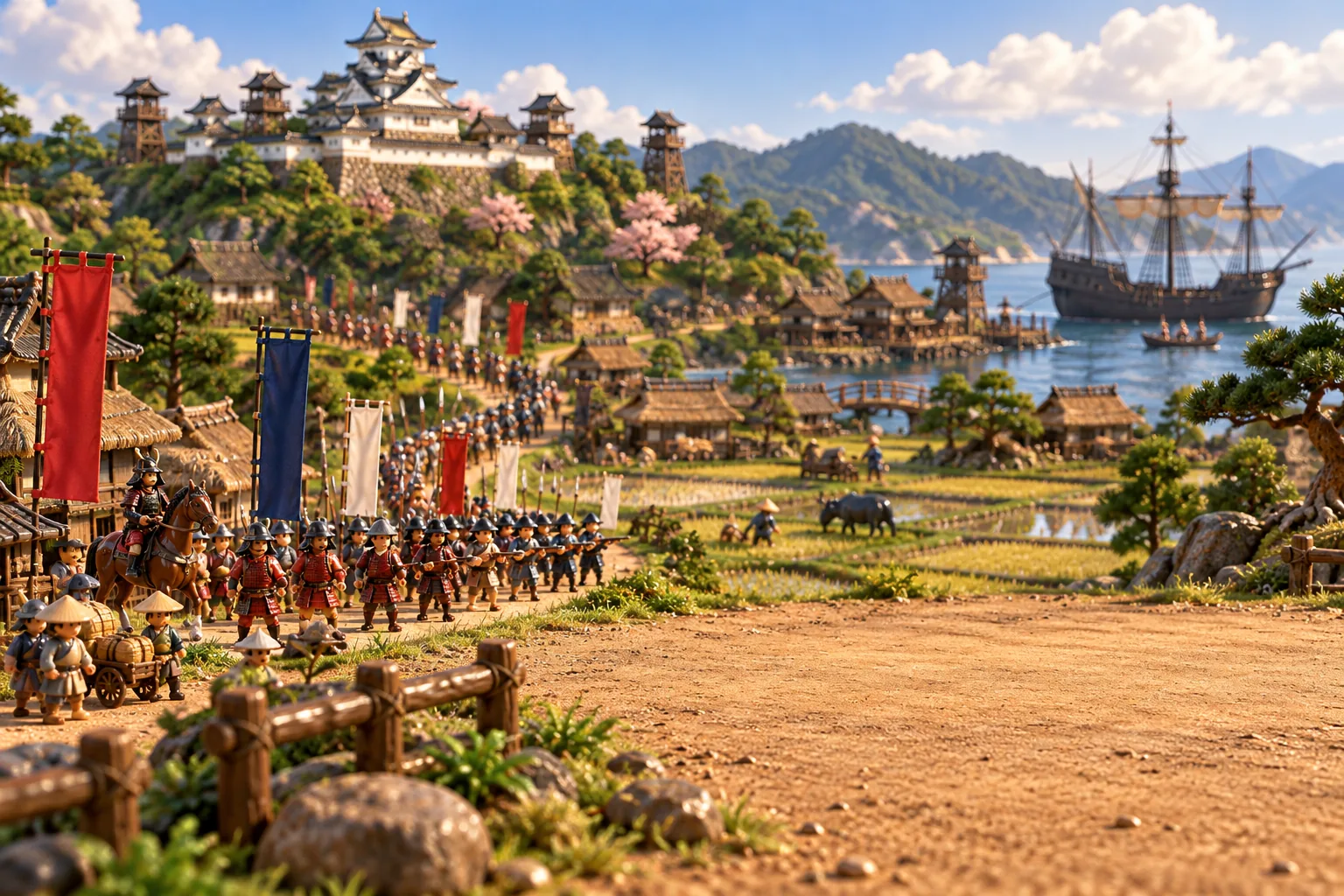
For more than a century Japanese lords fought almost without pause, until three men, Nobunaga, Hideyoshi and Ieyasu, pulled the country together, helped by guns first brought by the Portuguese.
The Ōnin War of 1467–1477, a quarrel over who would follow the shogun Ashikaga Yoshimasa, devastated two-thirds of Kyoto and broke the power of the Ashikaga shoguns. Provincial lords went home and ruled on their own as sengoku daimyo, and many were overthrown by their own deputies, a pattern called gekokujō, "the low conquers the high". Hōjō Sōun, a man of humble origins, seized Izu Province in the 1490s, and peasants, monks and merchants rose in leagues called ikki.
In 1543 the Portuguese brought the matchlock gun to Japan, where it was mass-produced as the tanegashima. Oda Nobunaga used guns best: he controlled gunsmiths, dealt with the merchants of Sakai and built Azuchi Castle. He beat Imagawa Yoshimoto at Okehazama in 1560, entered Kyoto in 1568, ended the Ashikaga shogunate in 1573 and defeated Takeda Katsuyori at Nagashino in 1575. In 1582 his vassal Akechi Mitsuhide turned on him in the Honnō-ji Incident and drove him to suicide.
Toyotomi Hideyoshi, born a peasant, beat Mitsuhide at Yamazaki only 11 days later. He began Osaka Castle in 1583, became imperial regent in 1586, conquered Shikoku and Kyushu, banned war between daimyo in 1587 and completed the unification of Japan after the siege of Odawara in 1590. He died in 1598. Tokugawa Ieyasu won the Battle of Sekigahara in 1600 and founded the Tokugawa shogunate in 1603.
Read more on Wikipedia
Sources: en.wikipedia.org/wiki/Sengoku period, en.wikipedia.org/wiki/Tokugawa shogunate


