Antiquity · state
Seleucid Empire
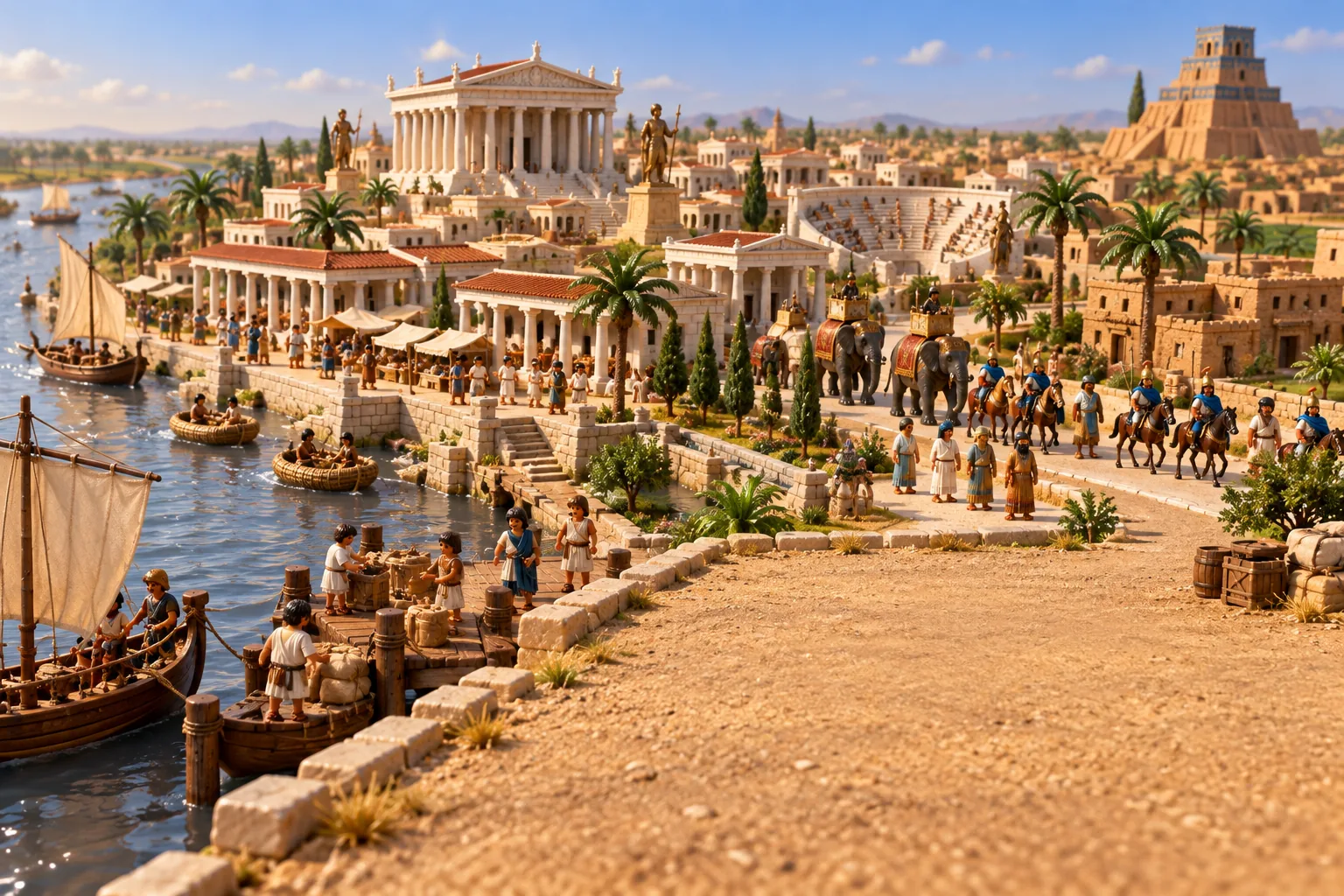
One of Alexander's generals built a Greek empire stretching toward India, and traded the Indus lands for 500 war elephants.
When Alexander the Great died, his generals divided his conquests. Seleucus, who had commanded the Companion cavalry, received Babylonia, lost it to his rival Antigonus around 315 BC and came back in 311 BC. From there he marched east into Iran and Central Asia and fought the Indian ruler Chandragupta Maurya, giving up the lands along the Indus in return for an alliance.
Chandragupta's gift of 500 war elephants helped Seleucus and Lysimachus defeat Antigonus at Ipsus in 301 BC, and Seleucus took northern Syria and eastern Anatolia. He founded two capitals, Seleucia on the Tigris and Antioch on the Orontes, which he named after his father. At its height the empire reached from Anatolia to Afghanistan. A Greek-speaking elite ruled from Greek cities, while local traditions were generally tolerated.
In the third century BC Bactria and Parthia broke away. Antiochus III the Great won back much of the east, but Rome defeated him at Magnesia in 190 BC. His son Antiochus IV's Hellenising policies set off the Maccabean revolt in Judea, and the Parthians took Mesopotamia. Reduced to a rump state in Syria, the dynasty was ended by the Roman general Pompey, who made Syria a Roman province in 63 BC.
Read more on Wikipedia
Sources: en.wikipedia.org/wiki/Seleucid Empire, en.wikipedia.org/wiki/Seleucus I Nicator


