
Middle Ages · person
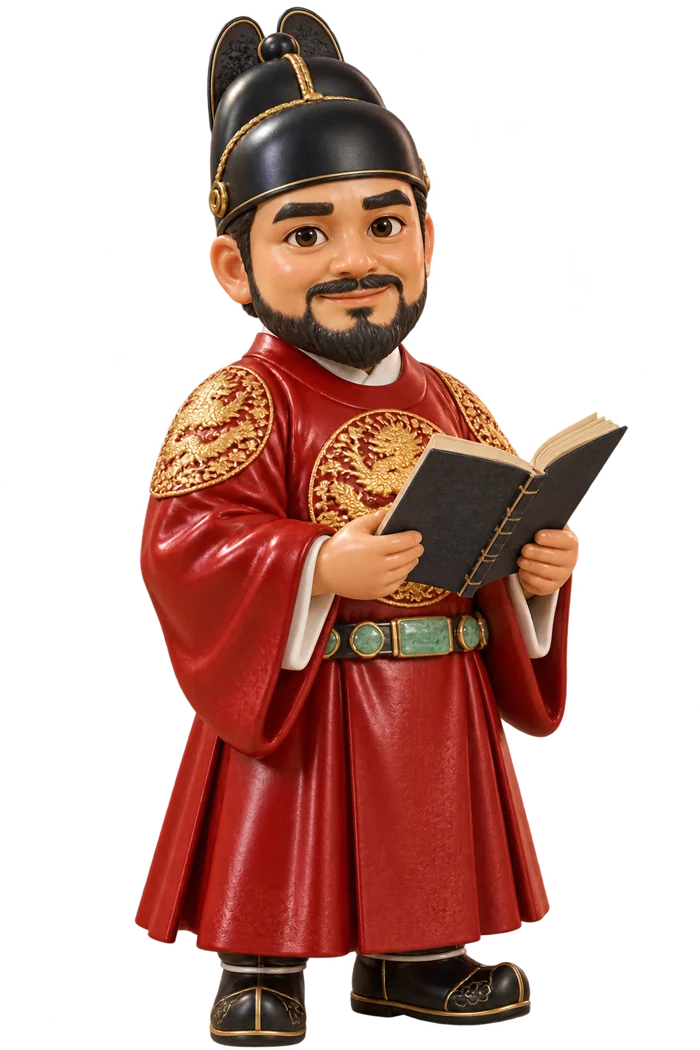
Sejong the Great
Distressed that common people could not write down what they wanted to say, a king designed 28 letters for everyone to practise at their ease.
Yi To was born in 1397 in Hanyang, today's Seoul, five years after the founding of Joseon, the third son of the prince who became King Taejong. A story has it that he read so much as a boy that his father took his books away, and he missed one, which Yi To read over and over. Nobody expected him to rule, but in 1418 his troubled elder brother was deposed, Sejong was named crown prince, and within months his father abdicated in his favour.
He revived the Hall of Worthies in 1420 and filled his reign with projects in which he took part himself. After a solar eclipse arrived two days late in 1432, he ordered astronomical instruments: an armillary sphere in 1433 and a water clock by Chang Yŏngsil in 1434, and in 1441 a rain gauge, centuries ahead of Europe's. His court worked out Korea's first native calendar. Above all he wanted ordinary people to write. Chinese characters suited neither the Korean language nor the poor, and in the 12th lunar month of 1443 he revealed a new script to his court. Scholars led by Ch'oe Malli protested that it betrayed Chinese civilisation, but in 1446 it was published as Hunminjeongeum, The Correct Sounds for the Instruction of the People.
Sejong suffered for years from pain and failing sight and handed daily business to his son, the future Munjong. He died in Gyeongbokgung in 1450, aged 52. Hangul was officially adopted only in 1894, but today it is Korea's alphabet.
Read more on Wikipedia
Sources: en.wikipedia.org/wiki/Sejong the Great, en.wikipedia.org/wiki/Hangul


