
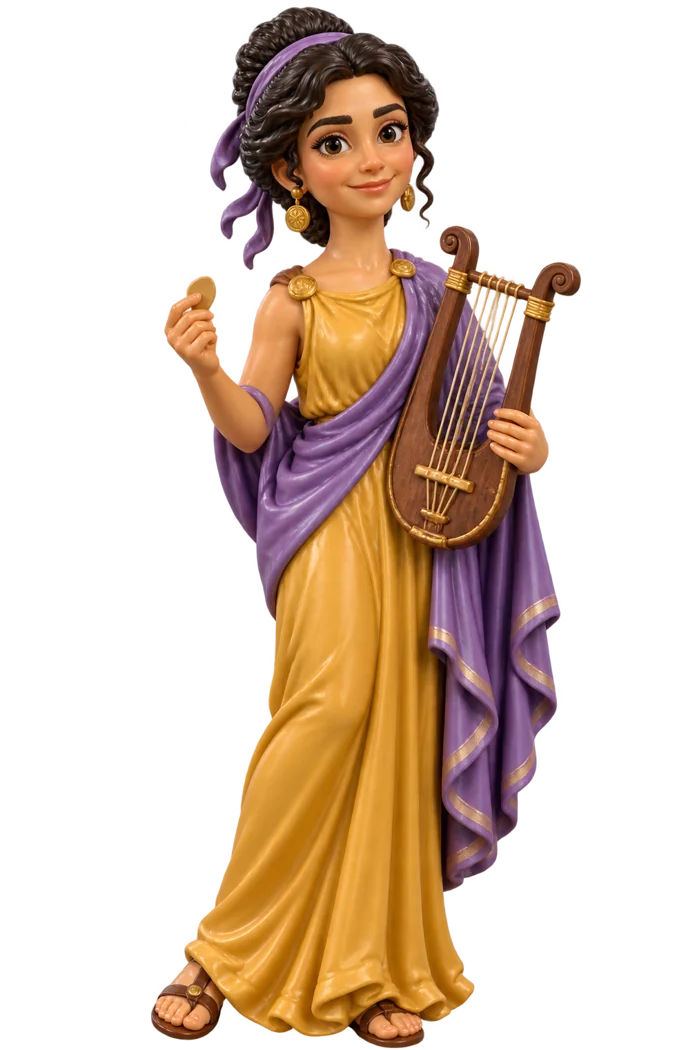
Ancient world · person
Sappho
Around 600 BC a woman on Lesbos sang of love to the deep notes of a lyre so well that later Greeks counted her as a tenth Muse, though nearly all her songs are lost.
Sappho, or Psappho in her own dialect, came from a wealthy, aristocratic family on the Greek island of Lesbos and lived at the end of the 7th and the start of the 6th century BC, in the time of the poet Alcaeus and the ruler Pittacus. Little about her life is certain. Ancient writers name three brothers, Charaxos, Larichos and Eurygios, and she may have had a daughter, Cleïs, who appears in two fragments. Around 600 BC she was exiled to Sicily, and she may have kept working until about 570 BC.
She composed lyric poems to be sung to music, probably some 10,000 lines, and is most closely linked with the barbitos, a deep-toned instrument like a lyre. Most of her songs were about love, others about family and religion. The scholars of Hellenistic Alexandria produced a critical edition of her poems and placed her in the canon of nine lyric poets; others called her the "Tenth Muse", or simply "the Poetess", as Homer was "the Poet".
Almost all of it was lost. Only the Ode to Aphrodite survives certainly complete; the rest are quotations in other authors and scraps of papyrus, many dug from an ancient rubbish dump at Oxyrhynchus in Egypt from the late 19th century. The story that she leapt from the Leucadian cliffs for love of the ferryman Phaon is only a legend. The Roman poet Catullus adopted the Sapphic stanza, and the English words sapphic and lesbian come from her name and her island.
Read more on Wikipedia
Sources: en.wikipedia.org/wiki/Sappho


