Industrial age · politics
Salt March
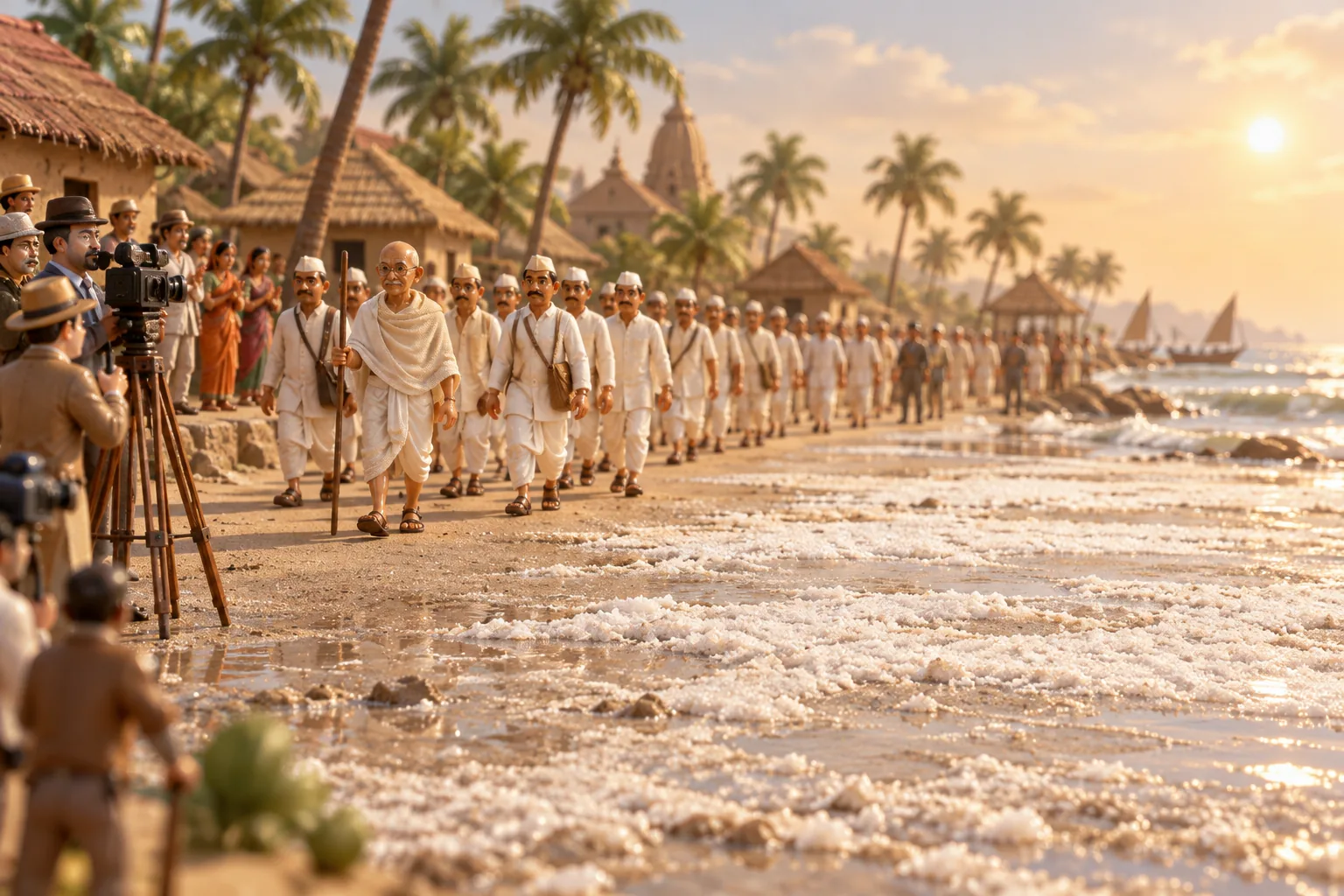
On a beach in Gujarat a thin man in a homespun cloth picked up a lump of salty mud and said it would shake the foundations of the British Empire.
Under the Salt Act of 1882 only the British government could make or sell salt in India, and it taxed it. Even people living by the sea, where salt could be had for free from seawater, had to buy it from government depots. On 26 January 1930 the Indian National Congress declared Purna Swaraj, complete self-rule, and Mahatma Gandhi chose the salt law as the first target of civil disobedience. On 2 March he wrote to the viceroy, Lord Irwin, offering to call the protest off if eleven demands were met. Irwin ignored him.
On 12 March 1930 Gandhi set out on foot from his Sabarmati Ashram with 78 volunteers. For 24 days they walked through 48 villages to Dandi on the Arabian Sea, about 387 km away, and thousands joined along the road. Newspapers and three Bombay film companies followed them. On the morning of 6 April, after a prayer, Gandhi raised a lump of salty mud and said: "With this, I am shaking the foundations of the British Empire." Then he boiled it in seawater and made illegal salt.
Millions of Indians began making and selling salt. Gandhi was arrested on the night of 4–5 May, just before a planned protest at the Dharasana Salt Works, where police beat hundreds of peaceful marchers in front of reporters. More than 60,000 people were jailed. The British made no big concessions at once, but the campaign drew the world's eyes to Indian independence.
Read more on Wikipedia
Sources: en.wikipedia.org/wiki/Salt March
