
Antiquity · person
Saint Nicholas
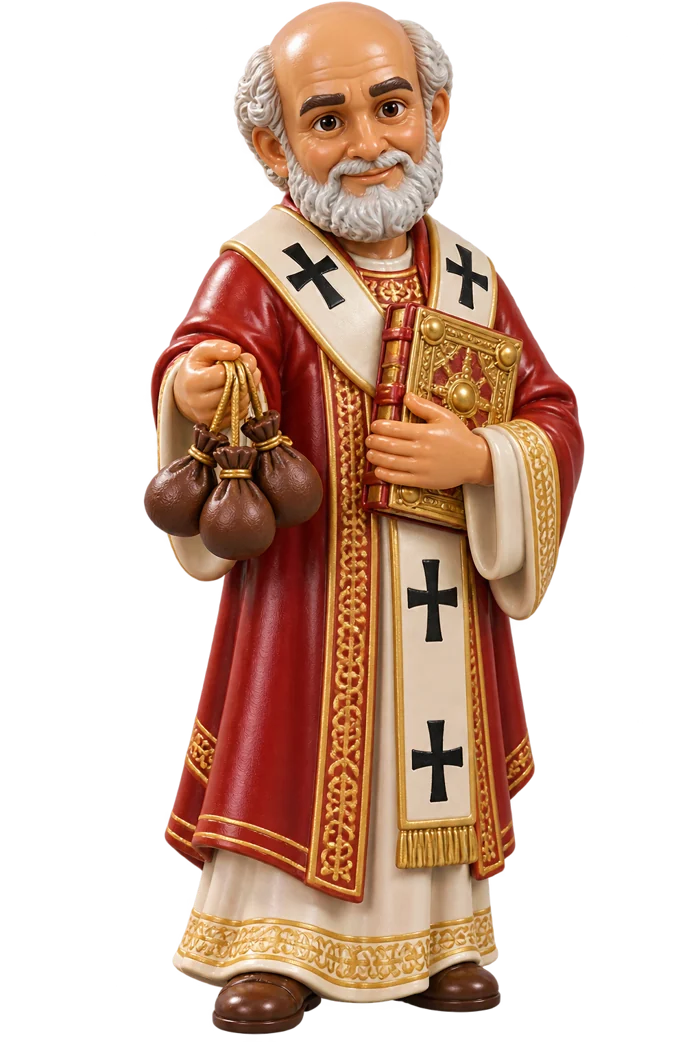
Three nights in a row, the story goes, a young priest of Lycia crept up to a poor man's house and tossed a bag of gold through the window, so his three daughters could marry.
Little is known about the real Nicholas. The earliest full Life of him, by Michael the Archimandrite, was written in the early 9th century, nearly 500 years after his death. Tradition says he was born in Patara, a port of Lycia in Roman Asia Minor, to wealthy Greek Christian parents, and that his uncle, the bishop of Myra, ordained him a priest. When his parents died in an epidemic, he is said to have given their wealth to the poor.
In his most famous story, a once-rich man could not pay dowries for his three daughters, who had no hope of marriage; on three nights Nicholas secretly threw a bag of gold coins through their window. After a journey to the Holy Land he came back to Myra just as its bishop died. The priests had agreed that the first priest to enter the church that morning would be bishop, and Nicholas, arriving to pray, was chosen. Other early stories tell how he calmed a storm at sea and saved three innocent men from execution.
An early list names him among the bishops at the Council of Nicaea in 325. He died, traditionally, on 6 December 343, now his feast day. In 1087 sailors from Bari carried most of his bones away from his church in Myra; they reached Bari on 9 May, and two years later Pope Urban II placed them in the new Basilica di San Nicola. Through the Dutch Sinterklaas, his secret gift-giving became the folklore of Santa Claus.
Read more on Wikipedia
Sources: en.wikipedia.org/wiki/Saint Nicholas
