Industrial age · war
Russo-Japanese War
Russia sent its Baltic Fleet 18,000 nautical miles round the world to save the war, and lost it in a single battle.
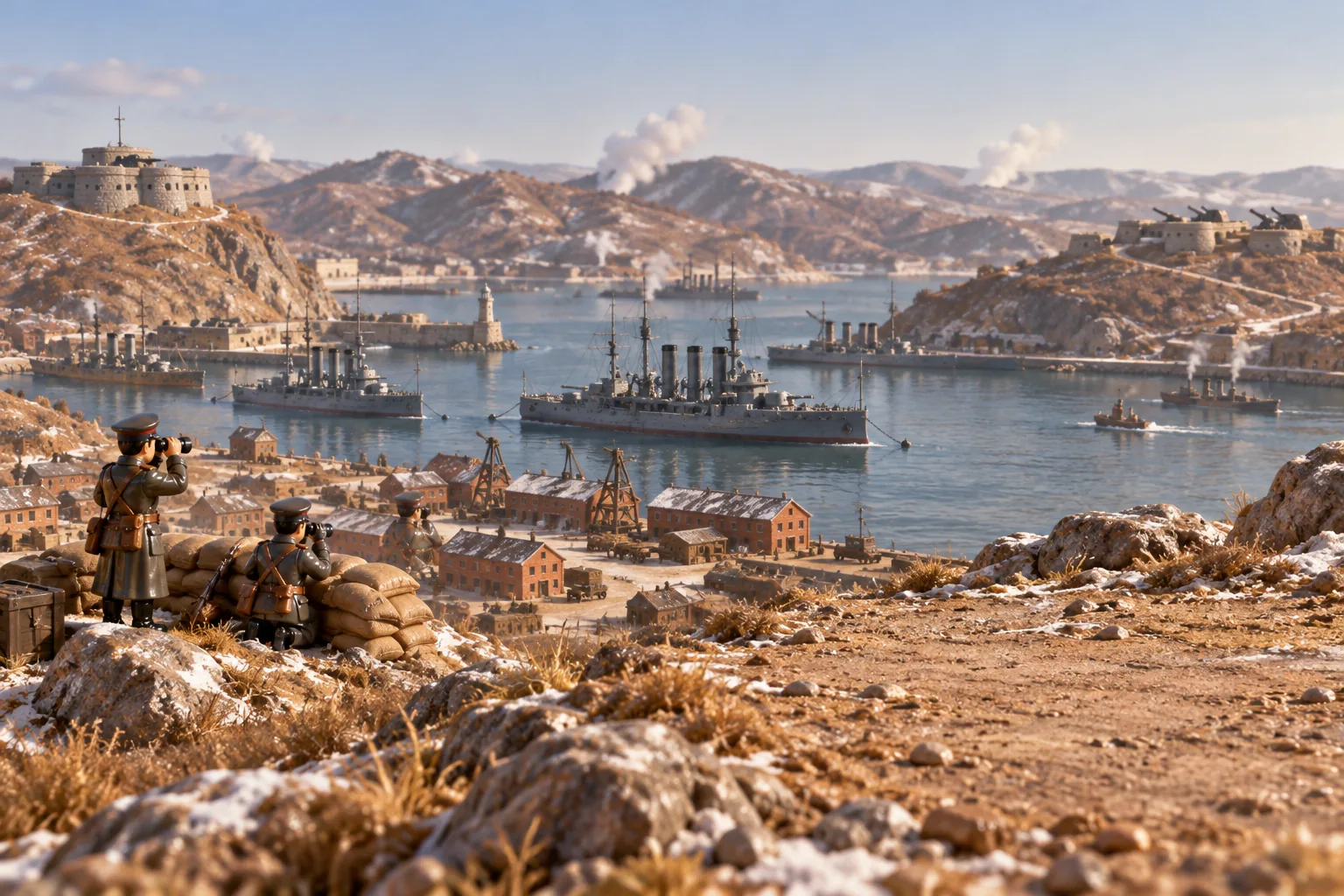
After Japan beat China in 1895, Russia, Germany and France forced it to give back the Liaodong Peninsula and its harbour, Port Arthur. Three years later Russia leased them itself, while it built the Trans-Siberian Railway and pushed into Korea. Japan, allied with Britain from 1902, offered to recognise Russian dominance in Manchuria if Russia accepted Korea as Japan's sphere. Russia refused.
On the night of 8–9 February 1904 Japan opened the war with a surprise attack on the Russian Pacific Fleet at Port Arthur. Japanese troops landed in Korea, crossed the Yalu River into Manchuria in May and laid siege to Port Arthur in August. The fortress held out for months until its commander, General Stessel, surrendered on 2 January 1905. In March the Japanese took Mukden, the Manchurian capital, after heavy fighting. Russia's last hope was its Baltic Fleet, which sailed for seven months and 18,000 nautical miles to reach the Pacific, only to be destroyed by Admiral Togo's Combined Fleet at Tsushima in May 1905.
The Treaty of Portsmouth, mediated by US President Theodore Roosevelt and signed on 5 September 1905, gave Japan Russia's lease on the Liaodong Peninsula, the South Manchuria Railway and the southern half of Sakhalin, and recognised its interests in Korea. Japan emerged as a great power. In Russia defeat fed the unrest of the 1905 Revolution.
Read more on Wikipedia