Our time · science
Roswell incident
For one day in July 1947 the US Army announced that it had captured a flying saucer; what it really had was tinfoil, rubber, tape and sticks.
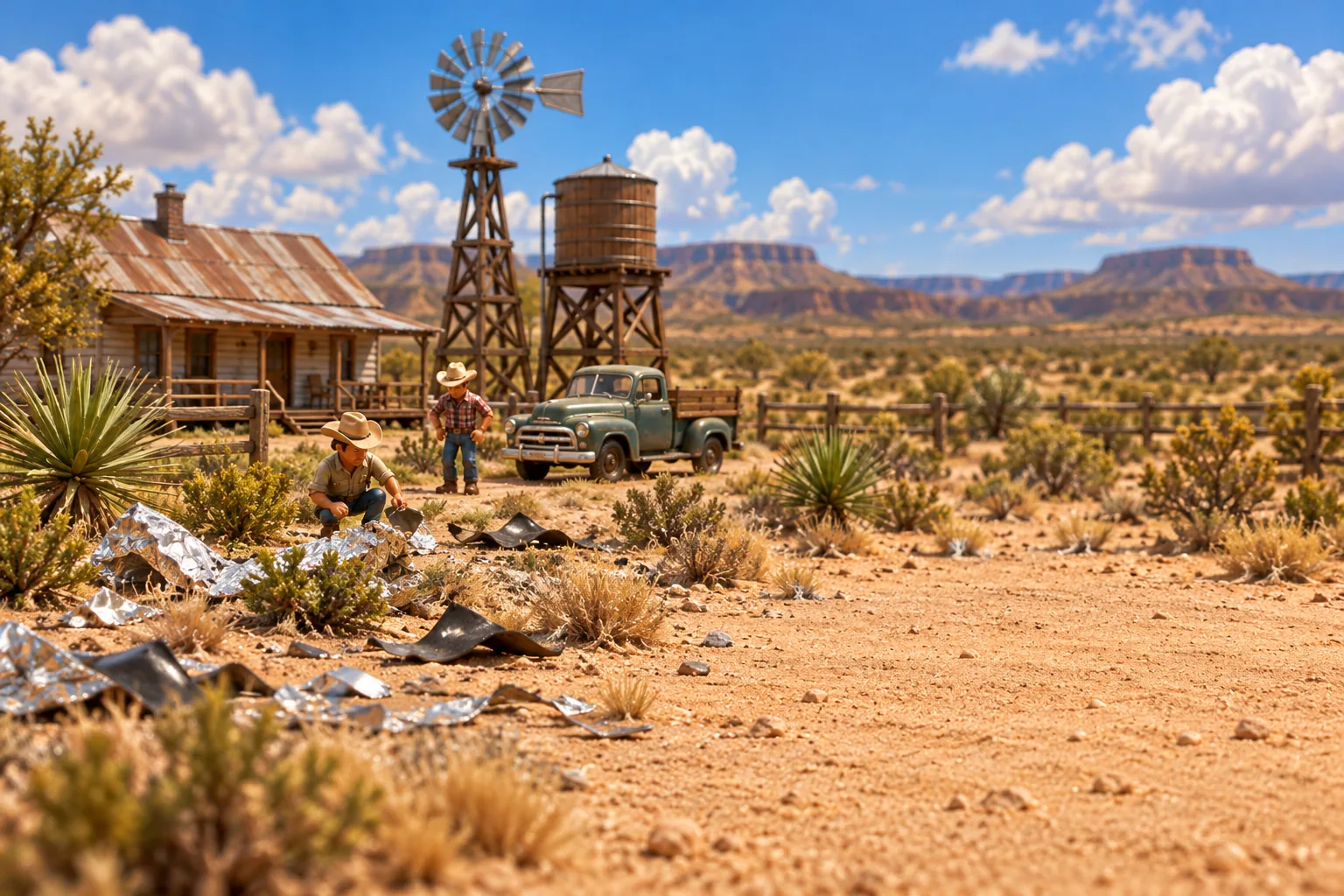
In the summer of 1947 America was gripped by a craze for "flying saucers". On 4 June researchers at Alamogordo Army Air Field in New Mexico launched a long train of balloons for Project Mogul, a top-secret program to listen for Soviet atomic tests, and lost it near a ranch outside Corona managed by W. W. "Mac" Brazel. Later that month Brazel found tinfoil, rubber, tape and thin wooden beams scattered over several acres. On 6 July he drove to Roswell and told the sheriff, who called Roswell Army Air Field.
Major Jesse Marcel and Captain Sheridan Cavitt went out to collect the debris. On 8 July the base's information officer, Walter Haut, issued a press release saying the military had gained possession of a "flying disc". The story went around the world. Within a day General Roger Ramey held a press conference in Fort Worth, Texas, where a weather officer identified the pieces as a weather balloon. That was itself a cover story, meant to hide the secret Mogul program, and the case was soon forgotten.
In 1978 the ufologist Stanton Friedman interviewed Marcel, who now said the weather balloon story was a cover-up and the debris was not of this Earth. The 1980 book The Roswell Incident spread the idea, and later tales added alien bodies, autopsies and more crashed saucers, none with any factual basis. Under pressure from Congressman Steven Schiff, the Air Force published reports from 1994 onward tracing the debris to Project Mogul. Roswell itself embraced the legend, with a yearly UFO festival since 1995.
Read more on Wikipedia