
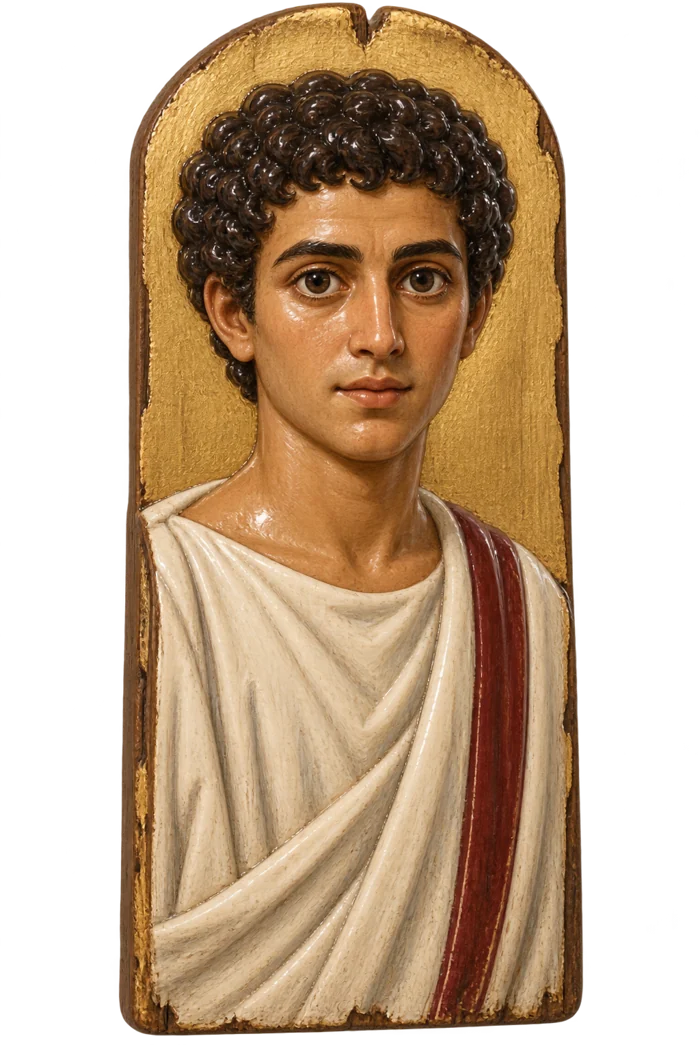
Antiquity · politics
Roman Egypt
For more than six centuries the land of the pharaohs was a Roman province, and Rome's emperors ruled it as pharaohs.
After Octavian won the naval battle of Actium, he invaded Egypt, and in August 30 BC Mark Antony and Cleopatra VII, the last Ptolemaic ruler, killed themselves. Octavian took the country as his personal possession. In 27 BC, when he became Augustus, Egypt was made an imperial province, Aegyptus, and the emperors ruled it as Roman pharaohs. Its governor was a prefect of equestrian rank chosen by the emperor, not a senator as in other provinces, and three legions guarded it at first.
Egypt was by far the richest Roman province outside Italy and a great producer of grain for the empire. Its capital, Alexandria, was the largest port and second-largest city of the Roman world. Somewhere between 4 and 8 million people lived in the province. Most were village farmers who spoke Egyptian, while the citizens of the towns spoke Greek and lived a Hellenistic life. In AD 212 all free Egyptians became Roman citizens.
The province was briefly taken by Queen Zenobia of Palmyra in 269 before Aurelian won it back. Under Constantine, from 324, the emperors promoted Christianity, and the Coptic language grew up among Egyptian Christians. In 541 the Justinianic Plague, the first great plague pandemic, broke out at Pelusium in Egypt. The Persians held the country for a decade from 618, and in 642 it passed for good to the Arab Rashidun Caliphate.
Read more on Wikipedia
Sources: en.wikipedia.org/wiki/Roman Egypt


