Middle Ages · state
Republic of Genoa
Its bankers financed Spain's empire, its merchants held colonies from Crimea to Chios, and Columbus was born in its territory.
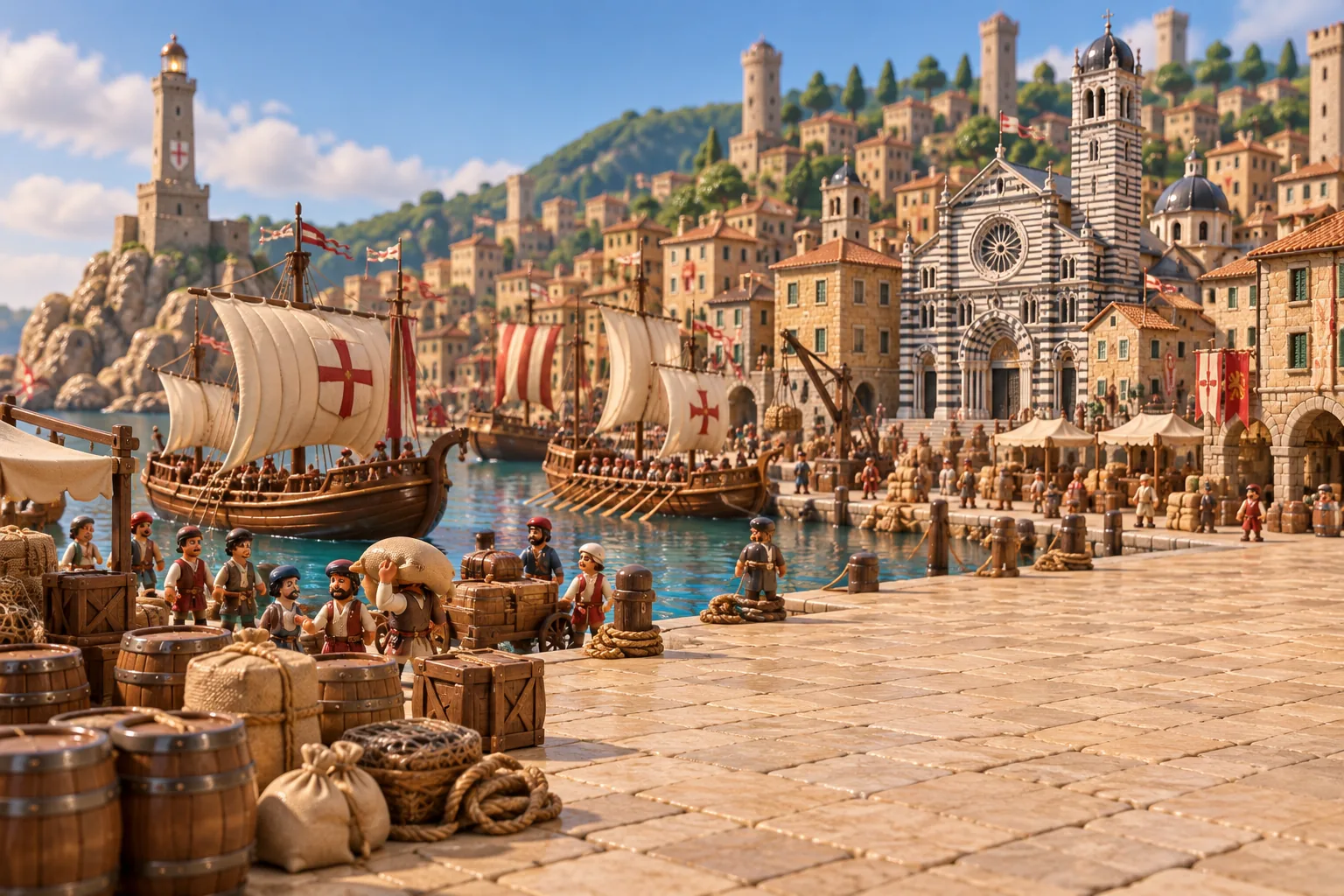
Genoa became a self-governing commune in the 11th century, and the Republic of Genoa is dated from 1099 to 1797. The destruction of an Arab fleet gave Genoa, Venice and Pisa control of the western Mediterranean, and Genoa began to expand overseas during the First Crusade, whose armies it helped to supply by sea. It was one of the Maritime Republics and an eternal rival of Venice.
In 1261 Genoa allied with the Byzantine emperor of Nicaea by the Treaty of Nymphaeum, and after the Byzantines retook Constantinople it won trading rights in the Black Sea. Its colonies stretched across the Mediterranean and the Black Sea: southern Crimea, where Caffa stood, from 1266 to 1475, the islands of Chios and Lesbos, and Corsica, formally annexed in 1347. In 1284 Genoa beat Pisa at Meloria for mastery of the Tyrrhenian Sea. From 1339 it was ruled by a doge, though in practice an oligarchy held power.
In 1407 Genoa founded the Bank of Saint George, one of the earliest banks in the world. In 1528 the admiral Andrea Doria allied with the emperor Charles V and restored the republic's independence. When Philip II went bankrupt in 1557, Genoese bankers replaced the Fuggers as Spain's financiers, and Fernand Braudel called 1557–1627 the 'age of the Genoese'. In 1797 Napoleon's France replaced the republic with the Ligurian Republic.
Read more on Wikipedia


