
Middle Ages · state
Republic of Florence
A city of wool merchants and bankers minted Europe's leading gold coin, raised Brunelleschi's dome and was run for sixty years by a family that held no crown.
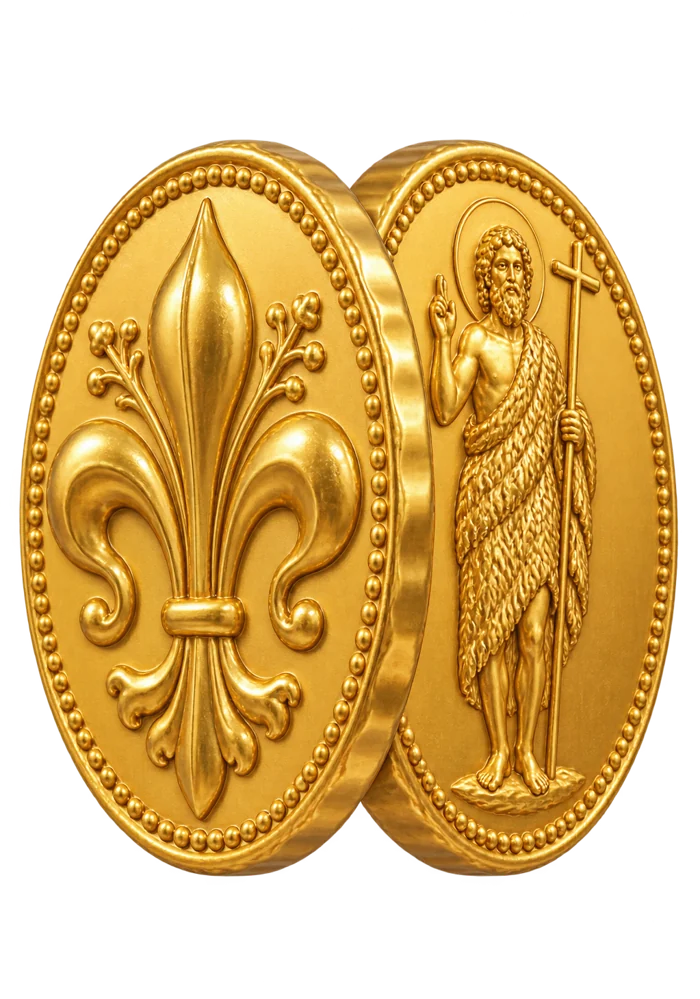
When Margravine Matilda of Tuscany died in 1115, Florence refused to obey her successor and governed itself as a commune. Its government, the Signoria, was chosen from the guilds, and its titular head, the gonfaloniere, was replaced every two months. Guelphs and Ghibellines fought over the city for a century. In 1252 the Guelphs introduced a gold coin, the florin, and in 1293 the Ordinances of Justice became the republic's constitution. Florentine banks spread across Europe, and the Palazzo della Signoria rose over the city.
The Black Death hit Florence hard, and in 1378 the wool workers rose in the Ciompi revolt. In 1406 Florence took its old rival Pisa after a long siege. From 1434 the banker Cosimo de' Medici ruled behind the republic's offices. He paid Brunelleschi, Donatello and Michelozzo, and the Renaissance flowered. His grandson Lorenzo the Magnificent survived the Pazzi conspiracy of 1478, in which his brother Giuliano was killed before his eyes.
The Medici were driven out in 1494, and the friar Girolamo Savonarola ruled until he was burned in the Piazza della Signoria in May 1498. Under Piero Soderini, his secretary Niccolò Machiavelli retook Pisa in 1509. The Medici returned in 1512, lost the city again in 1527 and won it back after an 11-month siege, and in 1532 Alessandro de' Medici became its hereditary duke.
Read more on Wikipedia
Sources: en.wikipedia.org/wiki/Republic of Florence, en.wikipedia.org/wiki/Florin, en.wikipedia.org/wiki/Lorenzo de' Medici