Middle Ages · war
Reconquista
It took almost 800 years, from a small victory in the mountains of Asturias to the surrender of the Alhambra.
In 711 Muslim armies crossed from North Africa and within a few years conquered most of the Visigothic kingdom of Iberia, which became al-Andalus. Only in the mountainous north did Christian rulers hold out. Around 718 or 722 the army of the Kingdom of Asturias won the Battle of Covadonga, the first Christian victory over the Umayyad forces since the invasion, and this is traditionally counted as the start of the Reconquista.
For centuries the frontier moved back and forth. In the early 11th century the Umayyad state of Córdoba broke up into small rival kingdoms called taifas, and the Christian kingdoms often forced them to pay tribute, called parias, for protection. In 1085 Alfonso VI of León and Castile took Toledo for good. Portugal became a kingdom in 1139. After the Almohads revived Muslim power in the 12th century, the Christian kingdoms won the decisive Battle of Las Navas de Tolosa in 1212. Córdoba fell in 1236 and Seville in 1248, leaving only the Emirate of Granada in the south, as a tributary state.
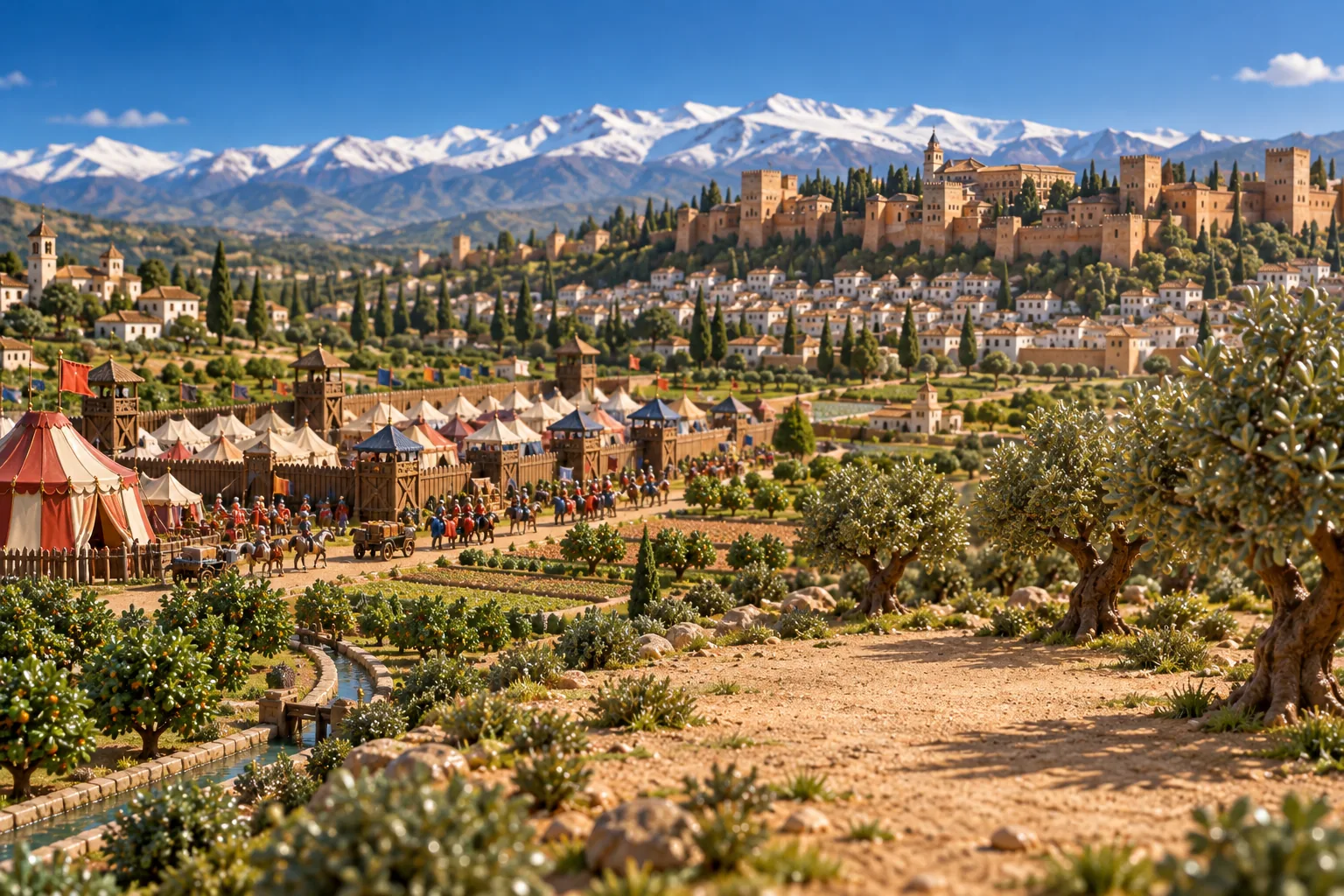
In 1482 Ferdinand and Isabella, the Catholic Monarchs, began a ten-year war against Granada, which surrendered on 2 January 1492, ending Muslim rule in Iberia. On 30 July that year the Alhambra Decree expelled the Jewish communities of Castile and Aragon, some 200,000 people, and between 1499 and 1526 a series of edicts forced Muslims to convert.
Read more on Wikipedia
Sources: en.wikipedia.org/wiki/Reconquista


