Antiquity · state
Qin dynasty
China's first imperial dynasty lasted only 15 years, yet its name is the likely source of the word China.
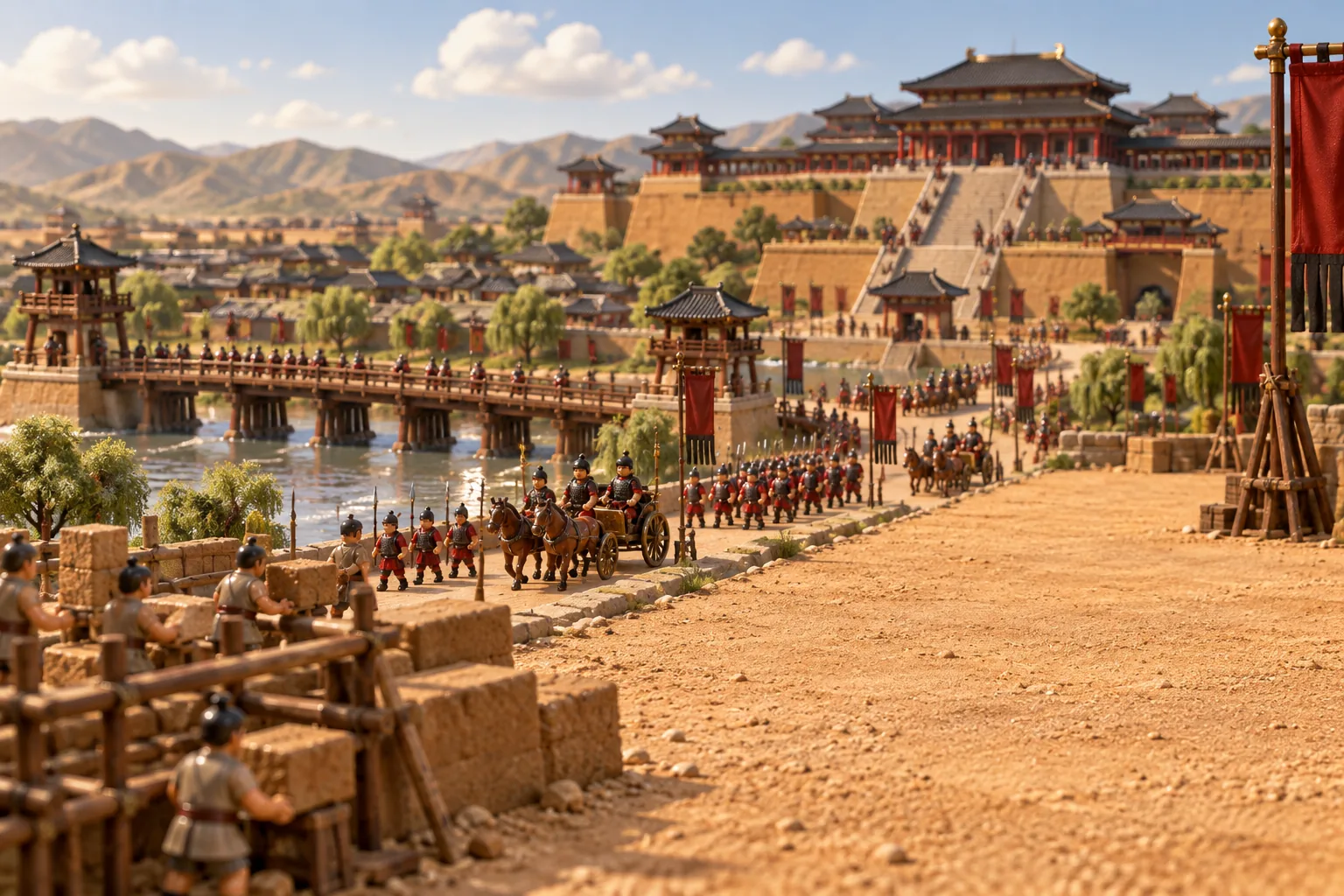
Qin was a minor state on China's western edge for centuries. In the 4th century BC the statesman Shang Yang reformed its army and government, and helped build a new capital at Xianyang on the Wei River. Irrigation works fed a large army. From 230 BC King Ying Zheng, who had come to the throne at the age of nine, conquered the rival Warring States one by one, ending with Qi in 221 BC.
Ying Zheng took a new title, Shi Huangdi, the First Emperor. Weapons from all over the realm were confiscated and melted down into twelve great statues at Xianyang. Currency, weights, measures and writing were standardised, down to the length of chariot axles. Hundreds of thousands of peasants and convicts joined the walls along the northern frontier into an early Great Wall, and in 214 BC an army of 500,000 men was sent to conquer the south. The emperor survived three assassination attempts.
He died in 210 BC on a journey to the east, seeking an elixir of immortality. The eunuch Zhao Gao and the chancellor Li Si hid his death, forged an order for his heir Fusu to kill himself and put the younger son Huhai on the throne. Revolts broke out, and in 207 BC the last ruler, Ziying, surrendered to Liu Bang, who went on to found the Han dynasty.
Read more on Wikipedia
Sources: en.wikipedia.org/wiki/Qin dynasty, en.wikipedia.org/wiki/Terracotta Army


