
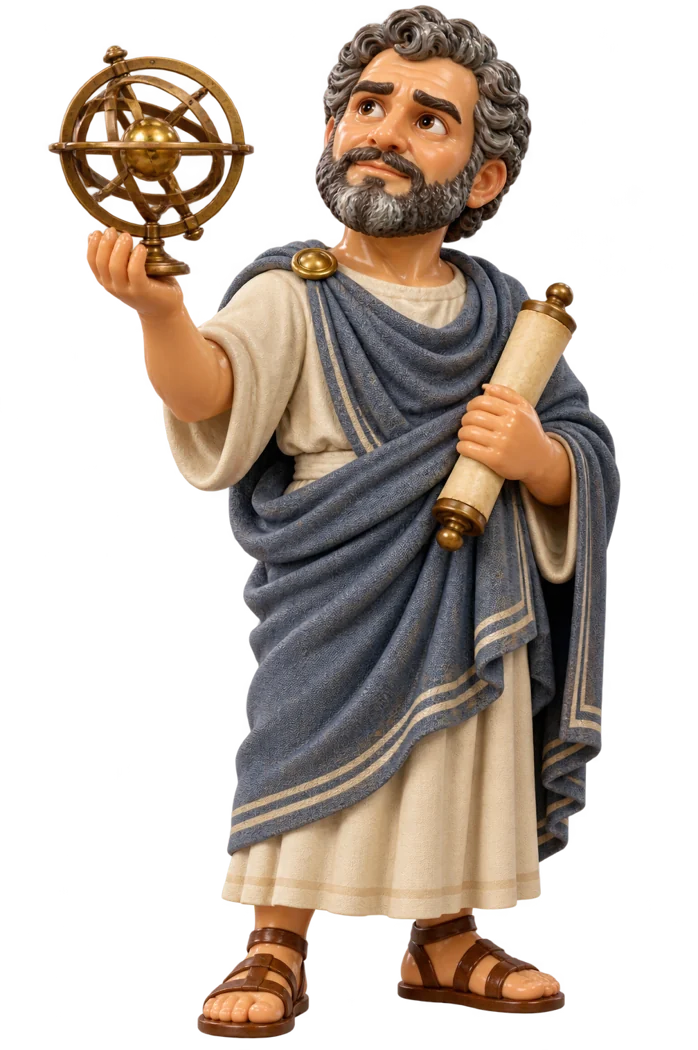
Antiquity · person
Ptolemy
From Alexandria he built a model of the heavens so complete, with the Earth at the centre and the planets on circles within circles, that it was accepted almost everywhere until the Scientific Revolution.
Claudius Ptolemy lived in or near Alexandria, in the Roman province of Egypt, in the 2nd century AD. Almost nothing is known of his life: neither the year nor the place of his birth, nor his family. His Roman name Claudius suggests that he was a Roman citizen, and he wrote in Koine Greek. He drew on observations made over more than 800 years, including Babylonian records and the work of the astronomer Hipparchus.
His great work, the Mathematical Treatise, set out a universe with the Earth fixed at its centre and the Sun, Moon and planets moving on circles within circles around it, with tables to work out where any planet had stood or would stand. It included a star catalogue arranged in 48 constellations, the ancestors of the ones used today. Around 146–147 he set up an inscription with his models in a temple at Canopus, near Alexandria. His Geography taught how to draw maps from coordinates and listed about 8,000 places, some 6,300 with a position on a grid. He also wrote the Tetrabiblos on astrology, the Harmonics on music and the Optics on sight, reflection and colour.
He died in Alexandria, perhaps around 170; the year is not recorded. Arabic scholars preserved his treatise, and its later name, the Almagest, is thought to come from an Arabic form of its Greek title, "the greatest treatise". It was translated into Latin twice in the 12th century, and his Earth-centred system was accepted almost everywhere until the Scientific Revolution.
Read more on Wikipedia
Sources: en.wikipedia.org/wiki/Ptolemy, en.wikipedia.org/wiki/Almagest


