Ancient world · state
Phoenicia
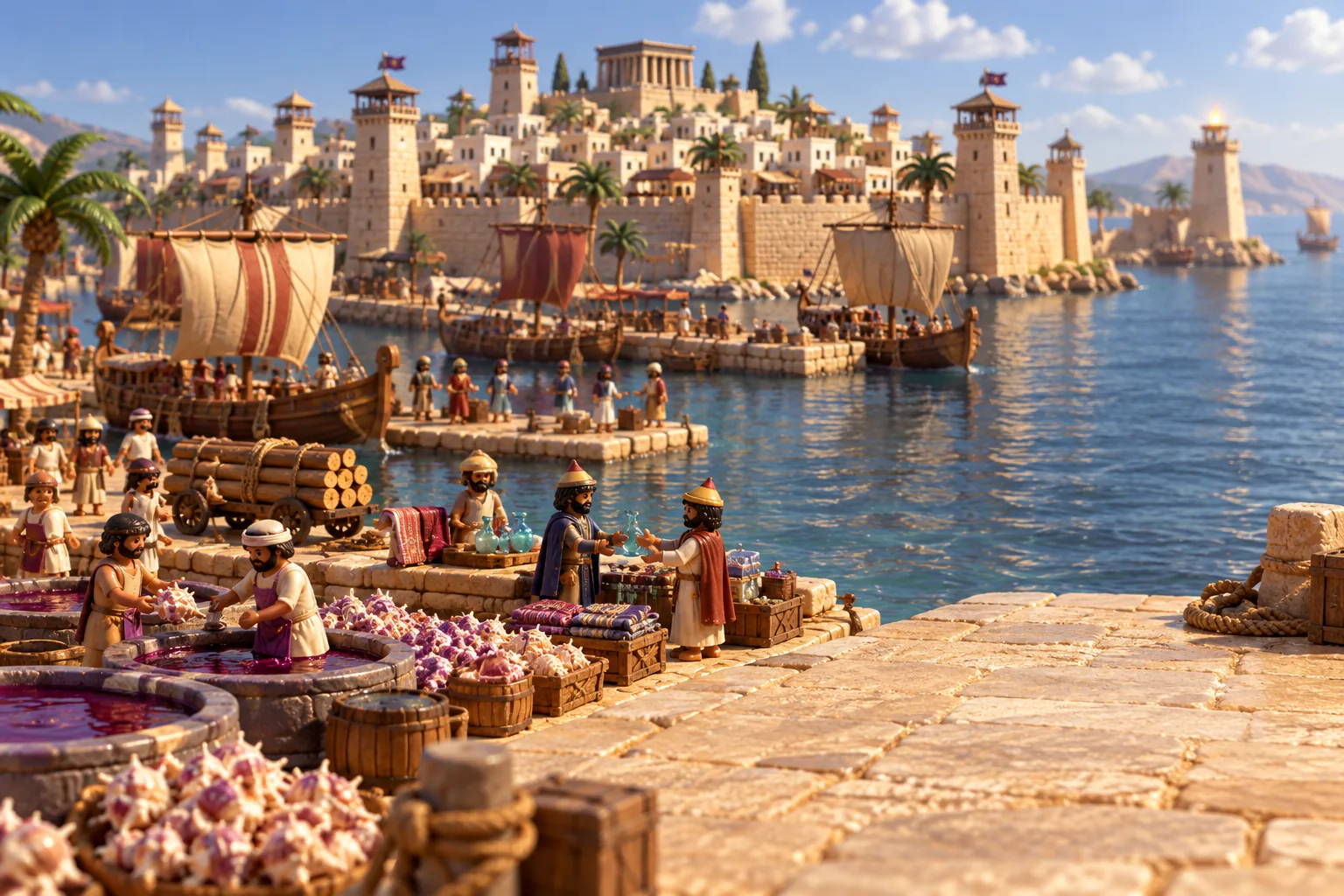
Phoenician traders spread the alphabet that became Greek and Latin letters, and dyed cloth purple with sea snails.
The Phoenicians were the Canaanite people of a string of independent city-states on the coast of today's Lebanon: Byblos, Sidon, Beirut, Arwad and, above all, Tyre. They never called themselves Phoenicians; the Greek word phoinix meant both a Phoenician and Tyrian purple, the costly crimson dye of their famous cloth. Egypt had long bought cedarwood from their mountains, and the cities survived the Bronze Age collapse to flourish in the Iron Age.
By the 10th century BC Tyre was the richest of them, especially under King Hiram I, whose craftsmen, the Hebrew Bible says, worked for King Solomon. The cities flourished most in the 9th century BC. Their ships founded colonies and trading posts on Cyprus, Sicily, Sardinia, Malta, the Balearics and the coasts of North Africa and Spain. Carthage, the New City, founded from Tyre and traditionally dated to 814 BC, grew into a great power.
Assyria demanded tribute from the kings of the seacoast and by 738 BC had annexed most of the Levant. The Babylonian Nebuchadnezzar II besieged Tyre for thirteen years, probably from 585 to 573 BC. Under Persian rule from 539 BC the Phoenicians kept their kings and supplied most of the Persian fleet in the wars against Greece.
Read more on Wikipedia
Sources: en.wikipedia.org/wiki/Phoenicia, en.wikipedia.org/wiki/Phoenician alphabet


