
Antiquity · science
Paper
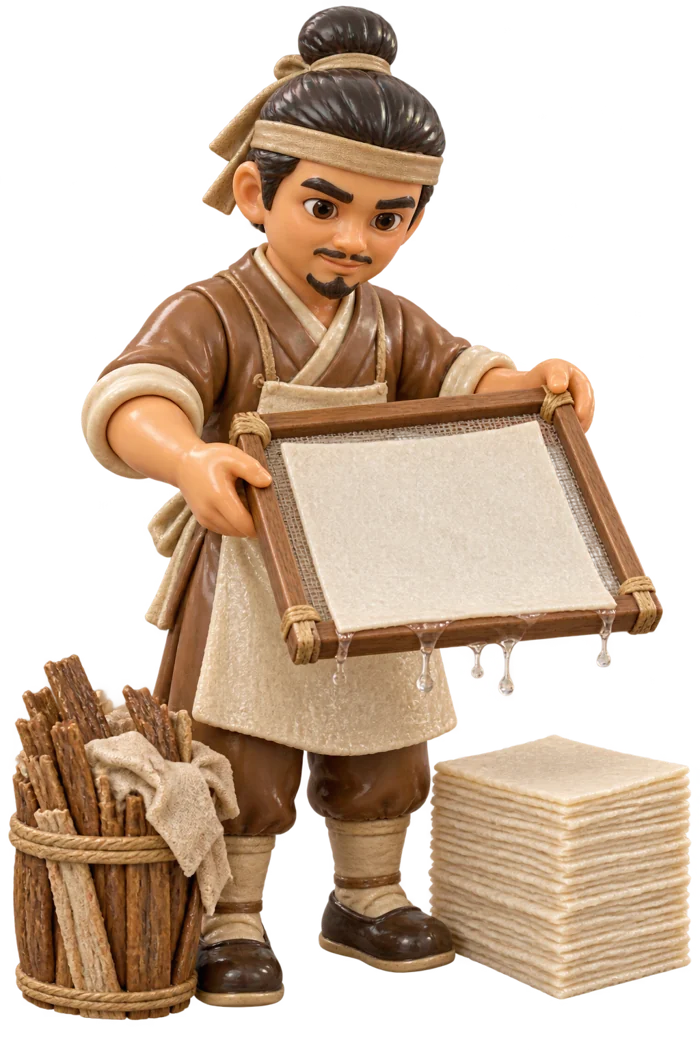
The paper that conquered the world was first made from tree bark, old rags and worn-out fishing nets.
In Han China most writing was done on strips of bamboo or wood, bound together. They were heavy, hard to store and awkward to write on. Silk was better but far too expensive for everyday use. Thin forms of paper had existed since the 3rd century BC, but none had replaced the slips.
Cai Lun, born into a poor family in the south, served at the imperial court in Luoyang as a eunuch official from at least AD 75, and rose to run the Palace Workshop that made the emperor's instruments and weapons. In 105 he presented a new way of making paper: a pulp of tree bark, hemp waste, old rags and fishing nets. It worked better than anything before. His paper soon pushed bamboo and wooden slips aside, and Emperor He rewarded him with fame and wealth; in 114 he was made a marquis.
Court politics ended his life. Years earlier Cai had helped Empress Dou remove a rival, Consort Song, who then took her own life. In 121 her grandson, Emperor An, ordered Cai to answer for it. Expecting a death sentence, Cai bathed, put on formal robes and drank poison. His method spread across China and by the 600s reached Korea, India and Central Asia. Chinese prisoners taken at the Battle of Talas passed it to the Arabs, and through them it reached Europe, where paper was being made widely by the 12th century.
Read more on Wikipedia
Sources: en.wikipedia.org/wiki/Cai Lun