Early modern · state
Ottoman Empire
A border chieftain in Anatolia founded a dynasty that ruled for six centuries, and his descendants turned Constantinople into Istanbul.
Around 1299 Osman, the leader of a small Turkish principality in north-western Anatolia, began to take land from the Byzantine Empire. His son Orhan captured Bursa in 1326 and made it the capital, and by the 1350s the Ottomans had crossed into Europe. They survived a crushing defeat by Timur at Ankara in 1402 and came back stronger.
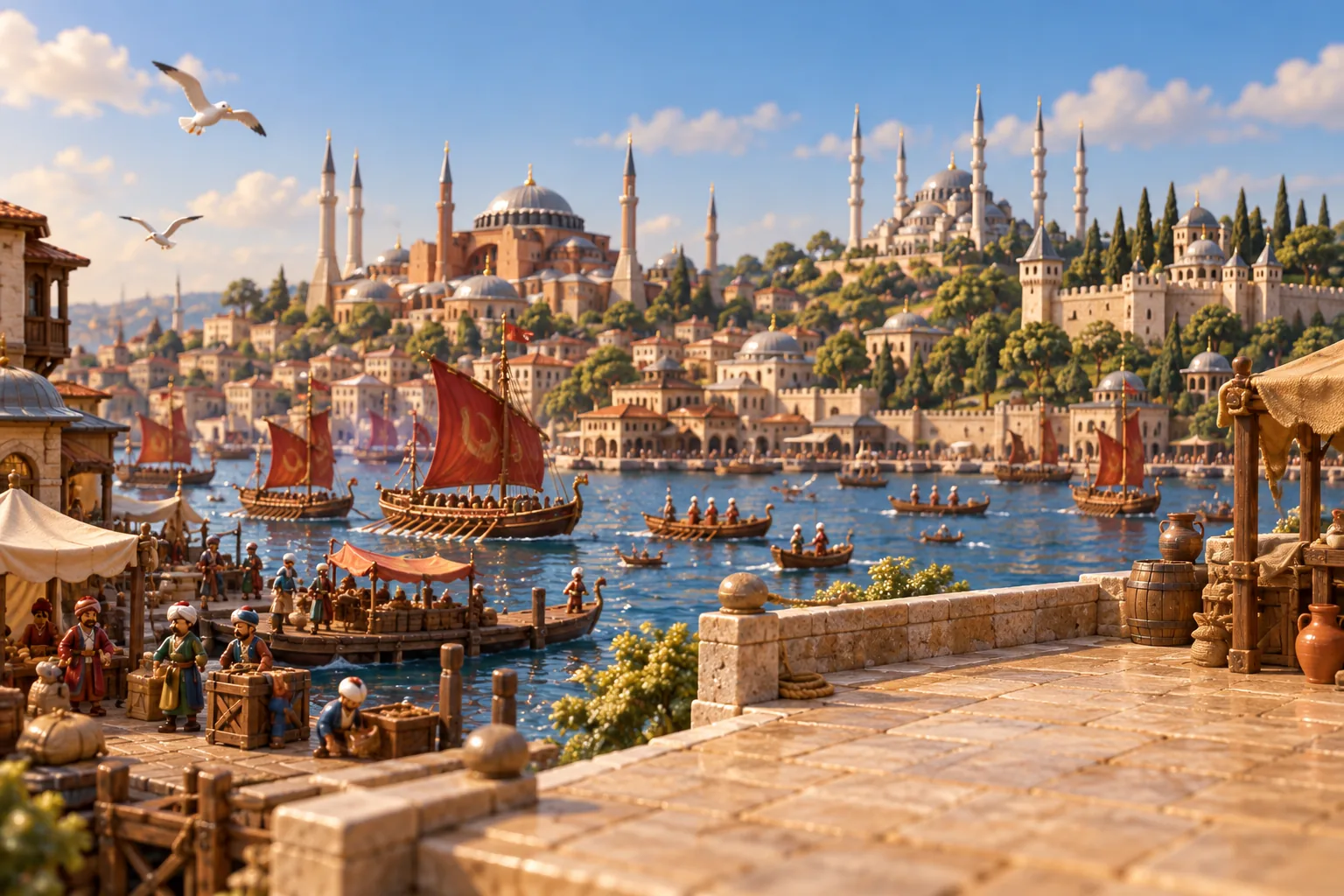
On 29 May 1453 the 21-year-old sultan Mehmed II took Constantinople after a siege of almost two months, and it became the Ottoman capital. His grandson Selim I conquered Syria and Egypt in 1516 and 1517. Under Suleiman the Magnificent, who reigned from 1520 to 1566, the empire took Belgrade, won at Mohács in 1526 and besieged Vienna in 1529. Turks remember Suleiman as the Lawgiver, and his architect Mimar Sinan built the Süleymaniye Mosque on a hill above the Golden Horn.
A second siege of Vienna failed in 1683, and the Treaty of Karlowitz in 1699 gave away large lands for the first time. In the nineteenth century the sultans tried reform, but European powers called the empire the sick man of Europe. It fought in the First World War on the losing side and was carved up. The sultanate was abolished on 1 November 1922, and the next year Mustafa Kemal declared the Republic of Turkey.
Read more on Wikipedia
Sources: en.wikipedia.org/wiki/Ottoman Empire, en.wikipedia.org/wiki/Janissary, en.wikipedia.org/wiki/Tulip period


