Industrial age · person
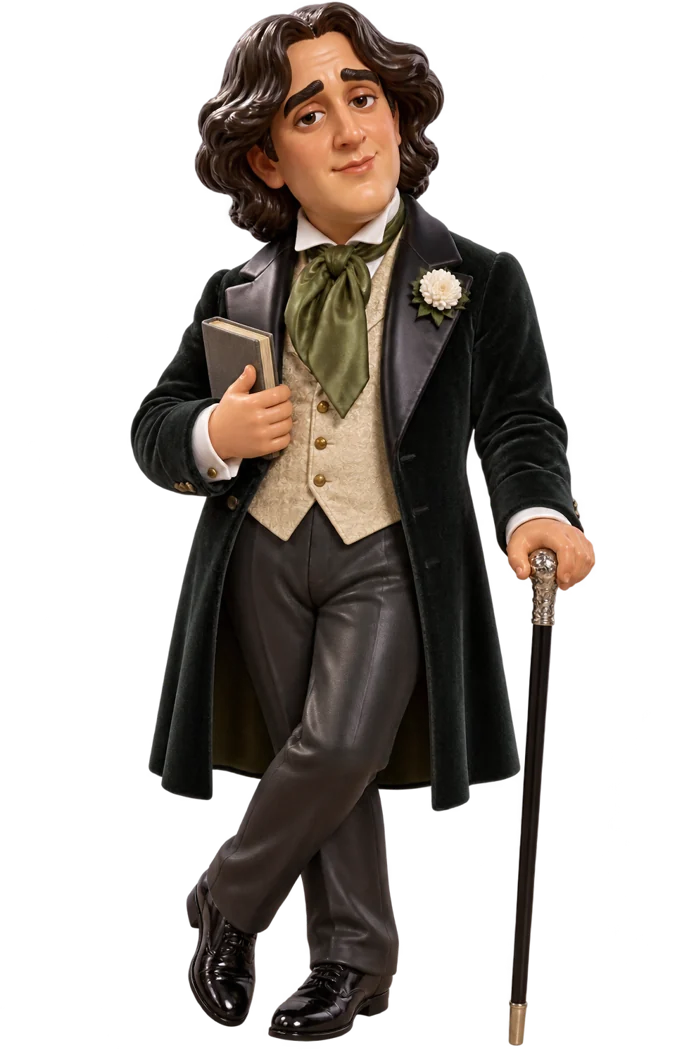
Oscar Wilde
A dinner with a magazine publisher led him to write his only novel, about a portrait that grows old in its owner's place, and five years later it was used against him in court.
Oscar Fingal O'Fflahertie Wills Wilde was born at 21 Westland Row, Dublin, on 16 October 1854, the second of three children of Jane Elgee and Sir William Wilde, Ireland's leading eye and ear surgeon. He was a brilliant classicist at Trinity College Dublin and at Magdalen College, Oxford, where he won the 1878 Newdigate Prize for his poem "Ravenna" and took up the aestheticism of his tutors Walter Pater and John Ruskin. In 1882 he lectured across the United States and Canada on art and interior decoration.
On 29 May 1884 he married Constance Lloyd, and they set up home at 34 Tite Street in Chelsea. On 30 August 1889 he dined at the Langham Hotel with Arthur Conan Doyle and the publisher of Lippincott's Monthly Magazine. The result was The Picture of Dorian Gray, the lead story in the July 1890 issue and a book in 1891: a beautiful young man stays young while his portrait records his sins. Some reviewers attacked its morals, and Wilde answered them in print. Wilde then conquered the stage with Lady Windermere's Fan in 1892 and The Importance of Being Earnest, first performed on 14 February 1895.
That year he sued the Marquess of Queensberry, father of his lover Lord Alfred Douglas, for libel. The case collapsed, Wilde was prosecuted for gross indecency and sentenced to two years' hard labour. Released in 1897, he wrote The Ballad of Reading Gaol, lived in France as "Sebastian Melmoth" and died of meningitis in a Paris hotel on 30 November 1900.
Read more on Wikipedia
Sources: en.wikipedia.org/wiki/Oscar Wilde