
Middle Ages · person
Ögedei Khan
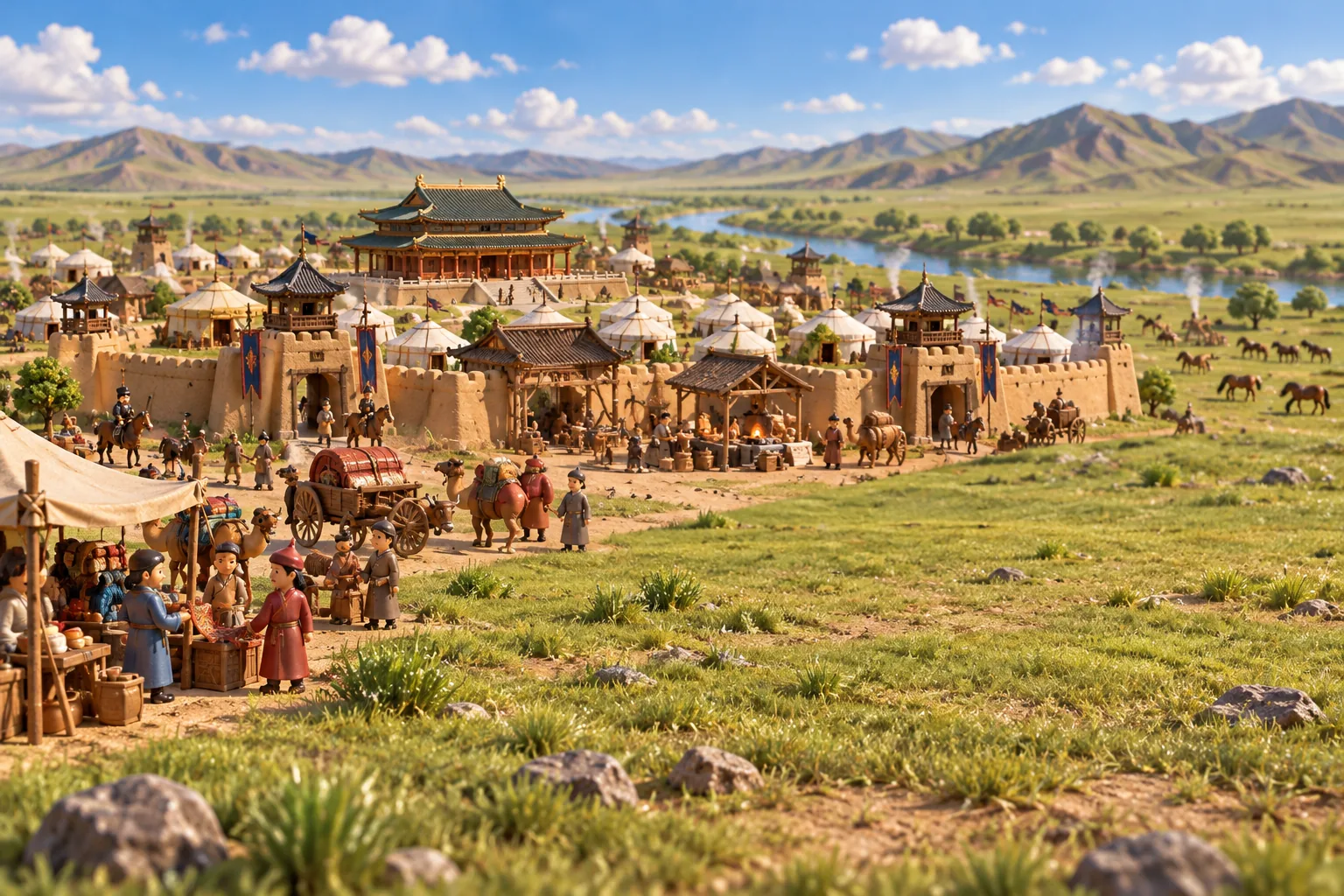
His father conquered from the saddle; in 1235 Ögedei finished a walled capital on the Mongolian steppe, Karakorum, with quarters for Muslim and Chinese craftsmen and earthen walls with four gates.
Ögedei was born around 1186, the third son of Temüjin, the future Genghis Khan, and his wife Börte. He fought in his father's wars from youth and was badly wounded in one battle. In 1204 his father gave him Töregene, the wife of a defeated Merkit chief, as a wife. When his elder brothers Jochi and Chagatai quarrelled during the siege of Gurganj, Genghis put Ögedei in sole command, and his capture of the city in 1221 made his name. The brothers' feuding led Genghis to choose Ögedei as his heir.
Genghis died in 1227, and after a regency under his younger brother Tolui, Ögedei was elected khan in 1229 at a kurultai on the Kherlen River, after ritually declining three times. With officials such as Yelü Chucai he organised taxes and regional governments, and in 1234 he set up the yam, a chain of relay stations about every 25 miles. His armies completed the conquest of the Jin dynasty in 1234 and invaded Korea, Persia and Georgia, and in 1235 Karakorum was finished.
His nephew Batu and the general Subutai led armies deep into Europe, defeating the Poles at Legnica and the Hungarians at Mohi. Ögedei died at dawn on 11 December 1241 after a late-night drinking bout, and the armies in Europe withdrew, probably to settle the succession. His widow Töregene ruled as regent for five years until their son Güyük became khan.
Read more on Wikipedia
Sources: en.wikipedia.org/wiki/Ögedei Khan, en.wikipedia.org/wiki/Karakorum

