Middle Ages · war
Norman Conquest of England
King Harold had to fight two invasions within three weeks, one in the far north and one on the south coast.
Edward the Confessor, the childless Anglo-Saxon king of England, may have encouraged his relative William, Duke of Normandy, to hope for the throne. But when Edward died in January 1066 he was succeeded by his brother-in-law, Harold Godwinson. That September another claimant, the Norwegian king Harald Hardrada, invaded northern England and won the Battle of Fulford on 20 September. Harold marched north and defeated and killed Hardrada at Stamford Bridge on 25 September.
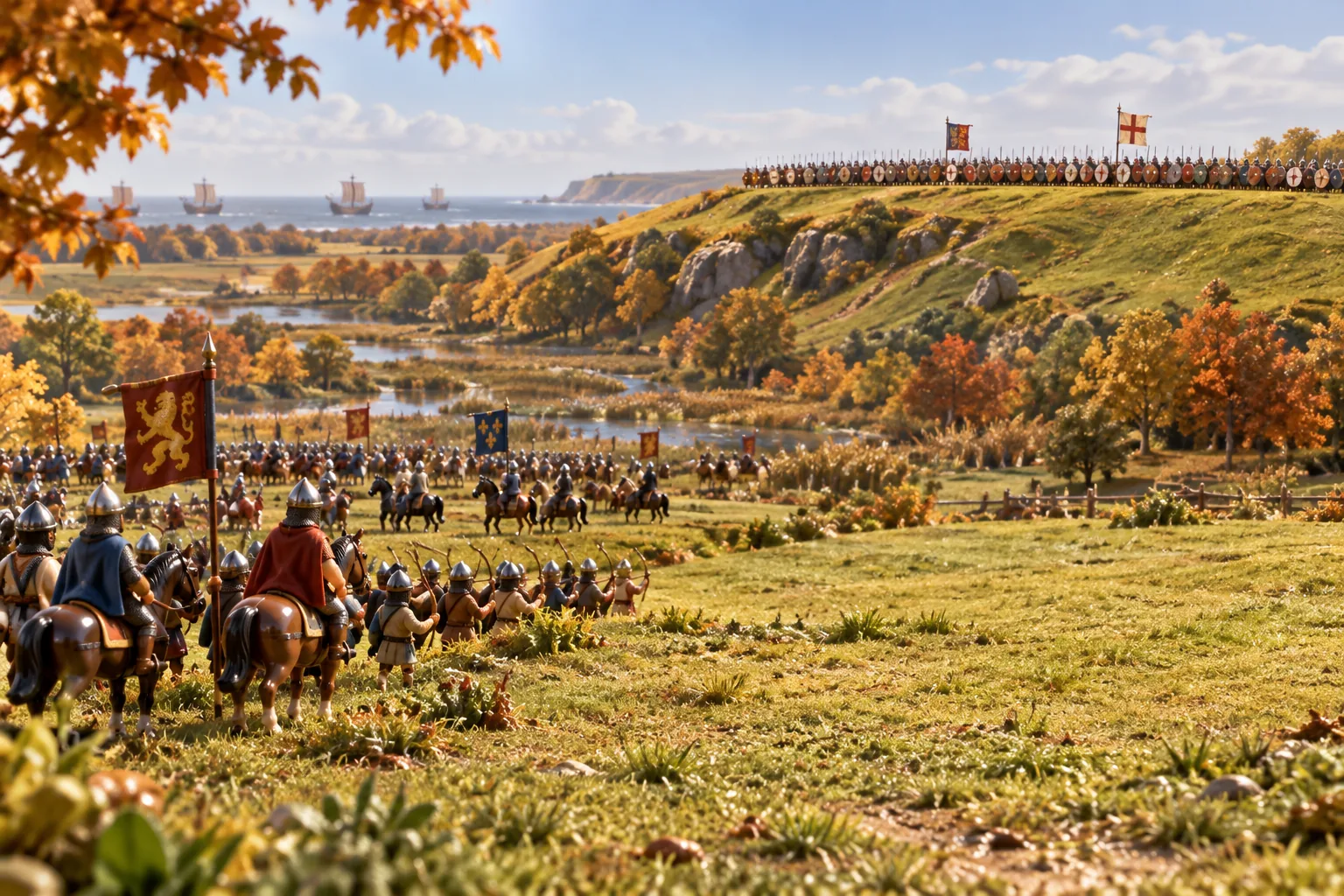
Three days later William's army of Normans, French, Flemings and Bretons, carried in hundreds of ships, landed at Pevensey in Sussex. Harold hurried south, leaving much of his army behind. On 14 October he took up a defensive position on Senlac Hill, about 10 km from William's castle at Hastings, with his housecarls and the fyrd, the local militia, fighting on foot. In the battle that followed Harold was killed and his army broken. The English leaders proclaimed Edgar Ætheling king, but they soon submitted, and William was crowned in Westminster Abbey on Christmas Day 1066.
Rebellions went on for years. In the winter of 1069–1070 William's forces devastated Northumbria in the Harrying of the North, and in the Fens Hereward the Wake fought on with Danish help. The lands of the English elite were given to William's followers, castles rose across the country, a dialect of French became the language of the ruling class, and by 1086 the great survey of the Domesday Book was complete.
Read more on Wikipedia